Damages for copyright infringement: what you can claim

On an infringement of copyright, you can seek the cessation of the infringement and damages, and in certain cases also a civil penalty. We explain what must be proved and how damages are assessed.
Where someone uses a copyright work without permission (a text, a photograph, music, software, a design or other protected content), the rightholder has several claims available. Slovenian copyright law (the Copyright and Related Rights Act, ZASP) protects the author both through the possibility of the cessation of the infringement and through monetary claims.
Our firm is entered in the register of representatives for designs and trademarks at the Slovenian Intellectual Property Office (reg. no. 337), which is relevant precisely to damages arising from infringements of intellectual property rights. Below we explain what can be claimed and how it is proved.
What can be claimed
The rightholder can generally seek the cessation of the infringement and a prohibition of further infringements, the removal or destruction of unlawful copies, damages for the loss caused, and publication of the judgment. It is often also possible to seek information about the origin and extent of the infringement.
These claims can be pursued together, for example, the cessation of the infringement together with damages.
Damages and an increased payment
Besides ordinary damages, in the event of an infringement the ZASP also allows an increased payment (a so-called civil penalty) where the infringement is committed intentionally or through gross negligence. This means that the rightholder can claim more than just the ordinary fee they would have received on lawful use.
The purpose of such a rule is to deter infringements and to ensure that infringement does not “pay”.
Proving the infringement and the loss
For a successful claim, one must show the existence and ownership of the right, the infringement (unauthorised use) and the extent of the use. It is sensible to document the infringement as soon as possible (screenshots, timestamps, examples of use) and to secure the evidence, since content online changes or is removed quickly.
For software, photographs and online content, securing the evidence in good time is often decisive.
Acting quickly and securing the position
For more serious infringements, an interim injunction can be sought for the immediate cessation of the infringement, before the proceedings conclude. Acting quickly reduces the loss and strengthens the negotiating position. Many infringements end in a settlement after a well-founded warning or an application for an injunction.
An example: unauthorised use of a photograph or text
A common case: a company publishes a photograph or text on its website without the author's permission. The author can seek the cessation of use, damages, and for an intentional infringement also an increased payment (civil penalty) under the ZASP, that is, more than just the fee they would have received on lawful use.
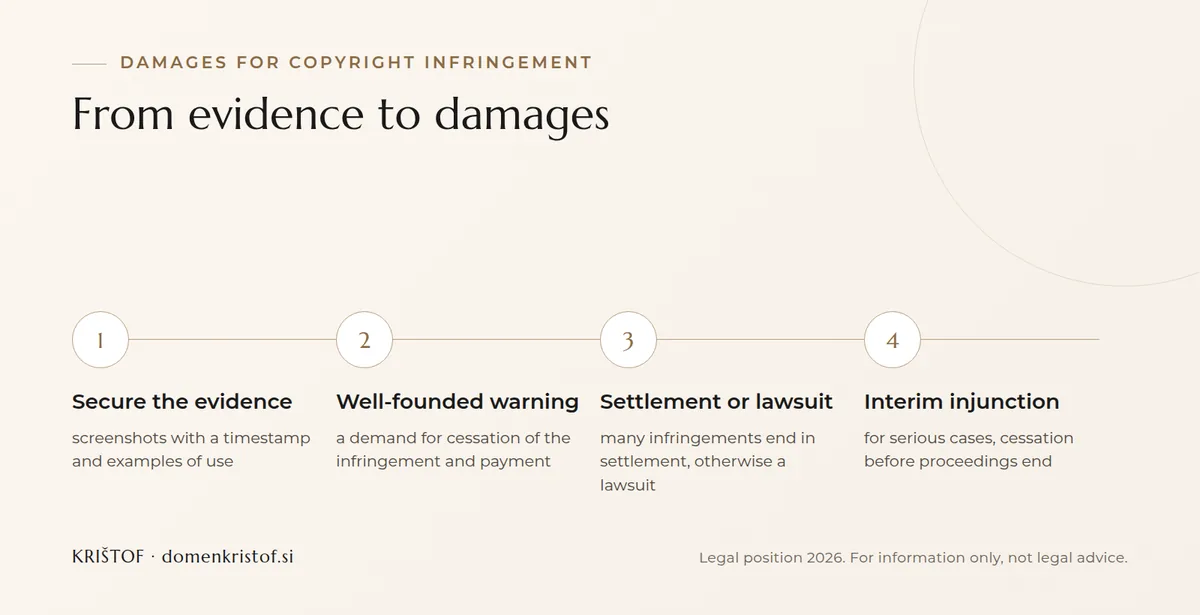
In practice we first secure the evidence (screenshots with a timestamp, examples of use), then send a well-founded warning with a demand for cessation and payment. Many infringements end here in a settlement. Otherwise a lawsuit follows, and for more serious infringements an interim injunction for immediate cessation.
The firm is entered in the register of representatives for designs and trademarks at the Slovenian Intellectual Property Office (reg. no. 337). These matters fall within damages in the field of intellectual property.
Copyright, trademarks and designs
It is important to distinguish the categories. Copyright arises on the creation of a work and does not require registration (texts, photographs, music, software). Trademarks and designs, on the other hand, are registered and protect distinctive signs or the appearance of a product. That is a separate field.
The firm is entered in the register of representatives for designs and trademarks at the Slovenian Intellectual Property Office (reg. no. 337), so we can help both with damages arising from infringements and with the registration and representation of intellectual property rights. For more serious infringements, we act quickly, with an interim injunction where necessary.
What is protected and what is not
Copyright law protects the expression, not the idea, process or data itself. What is protected is an individual intellectual creation (a text, a photograph, music, a computer program, a design), but not the general concept or the information behind it.
This distinction often decides whether an infringement exists at all. In assessing it, we also take into account any permissible exceptions (for example, quotation). The field connects damages with intellectual property rights, where the firm is bound by its entry in the register of representatives (reg. no. 337).
What to prepare for the initial consultation
It helps to have: evidence of authorship or ownership of the right, examples of unauthorised use (screenshots with a timestamp, links), any earlier correspondence, and information about the infringer.
On this basis we assess the infringement and the claims (cessation, damages, an increased payment), part of damages in the field of intellectual property.
What can I claim on an infringement?
Generally the cessation of the infringement, the removal of copies, damages and publication of the judgment, and often also information about the extent of the infringement. The claims can be pursued together.
What is an increased payment (civil penalty)?
Under the ZASP, for an intentional or grossly negligent infringement the rightholder can claim more than the ordinary fee. The purpose is to deter infringements.
How should I secure the evidence?
Document the infringement as soon as possible (screenshots, timestamps, examples of use). Online content changes quickly, so securing the evidence in good time is key.
Can an infringement be stopped immediately?
For more serious infringements, an interim injunction can be sought for immediate cessation, before the proceedings conclude.
How is the amount of damages determined?
The starting point is the fee the author would have received on lawful use. For an intentional or grossly negligent infringement, an increased payment can be sought under the ZASP.
Does protection apply even without registering copyright?
Yes. Copyright arises on the creation of a work and does not require registration. Trademarks and designs, for example, are registered. They are a separate category.
Legal sources
- Copyright and Related Rights Act (ZASP), PISRS (in Slovenian)
- Code of Obligations (OZ), PISRS (in Slovenian)
Links point to official sources (PISRS and the competent institutions). This article is general information and is not a substitute for legal advice.