Legal due diligence on a property before purchase: what to watch for

Legal due diligence on a property before purchase checks ownership, encumbrances, access and building status. We describe what is reviewed and which mistakes cost buyers the most.
For most people, buying a property is one of the largest investments of their lives, and that is precisely why it calls for checks that go beyond a viewing and an agreement on price. Legal due diligence on a property before signing shows whether the seller really is the owner, whether there are encumbrances on the property, and whether there are third-party rights that could jeopardise the purchase or its use.
Below we explain what the review covers and how the purchase price is secured on the transfer of ownership.
The Land Register and ownership
The starting point is the Land Register (ZK): we check who the registered owner is, whether it matches the seller, and whether the entry is clean. Slovenian law recognises the principle of trust in the Land Register, but the entry is not always complete (for example, transfers or inheritances not yet carried out), so the position must be checked carefully, not merely assumed.
Encumbrances, easements and annotations
We review the encumbrances (mortgages, land debt), easements (for example, a right of way or for utility lines), real burdens and annotations (for example, an annotation of a dispute, enforcement or priority ranking). Each of these can affect the value and use of the property, for instance, a mortgage that the seller does not discharge before the sale.
Pre-emption rights and the actual state
We check for the existence of pre-emption rights (statutory or contractual), which can complicate the purchase, and the correspondence between the actual and the legal state, for buildings, the question of the building and use permit and of legality. For condominium ownership, the proper establishment of that ownership.
A mismatch (for example, an unregistered extension or unlawful construction) is a risk better discovered before signing than after.
The costs of a purchase, the checks that apply to your property and the timing of payments for your transaction are set out in our tool Buying property in Slovenia: costs, checks and who can buy.
The contract and securing the purchase price
The review feeds into the sale contract, tailored to the specific property. Securing payment is key: the purchase price is often placed in notarial escrow (an escrow account) and released only on the simultaneous registration of ownership in the buyer's favour, free of encumbrances. In this way the buyer is protected, paying only on a clean transfer of ownership.
Step by step: what we check before purchase
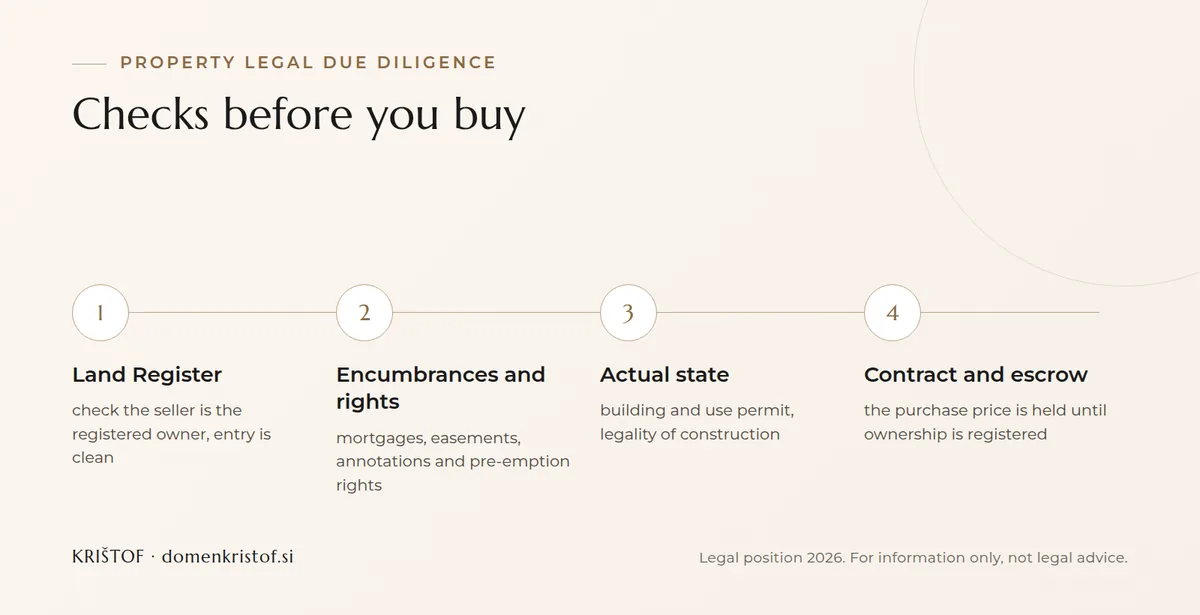
1) Land Register: whether the seller is the registered owner and whether the entry is clean. 2) Encumbrances and annotations: mortgages, easements, real burdens, annotations of a dispute or enforcement. 3) Pre-emption rights: statutory or contractual. 4) Actual state: the building and use permit, the legality of the construction, and for condominium ownership its proper establishment.
5) Contract and securing payment: we generally place the purchase price in notarial escrow (an escrow account), released only on the simultaneous registration of ownership in the buyer's favour, free of encumbrances. In this way the buyer pays only on a clean transfer. For buyers from abroad, the procedure connects with buying property as a foreigner.
Legal due diligence is at the heart of a safe transaction in the field of real estate.
Special cases: condominium ownership, agricultural land, new builds
Some properties call for extra attention. For condominium ownership, we check its proper establishment and the state of the common parts. For agricultural land, special rules on transactions and pre-emption rights apply. For new builds, the building and use permit and the contractor's warranties are to the fore.
When buying from a developer, security against the developer's insolvency and the order of registrations matter. We include all these questions in the review and the contract, so that the transaction remains safe, part of real estate law.
Earnest money, the contractual penalty and withdrawal
On a purchase, earnest money often appears, an amount paid at the conclusion of the contract, with consequences on withdrawal: if the buyer withdraws, they generally lose it. If the seller withdraws, they return double. It matters whether it is agreed as earnest money or as a part payment.
A contract may also contain a contractual penalty and conditions for withdrawal. We align these provisions with the securing of payment through notarial escrow, so that the consequences of any complication are clear, part of a safe transaction in the field of real estate.
What to prepare for the initial consultation
It helps to have: details of the property (address, plot number, ID mark), any Land Register extract, a draft contract, the energy performance certificate and, for buildings, information on the permits.
On this basis we carry out the legal due diligence and prepare a safe contract with secured payment, part of real estate law.
Is it enough to look at the Land Register extract?
The extract is a starting point, but not always the full picture (transfers not yet carried out, inheritances, the actual state). The review also covers encumbrances, easements, pre-emption rights and the legality of the construction.
How do I make sure I get clean ownership after payment?
With notarial escrow (an escrow account): the purchase price is released only on the simultaneous registration of ownership in the buyer's favour, free of encumbrances.
What is a pre-emption right?
The right of a particular person to buy the property in priority on the same terms. It can be statutory or contractual. If it exists, it must be taken into account before the transaction is concluded.
What does a mismatch between the actual and the legal state mean?
For example, an unregistered extension or unlawful construction. This is a risk that affects value and use. It is better discovered before signing.
What is notarial escrow (an escrow account)?
The notary holds the purchase price and pays it to the seller only once ownership is registered in the buyer's name, free of encumbrances. This assures the buyer that they pay only on a clean transfer.
How long does registration of ownership in the Land Register take?
It depends on the court's workload and the completeness of the documentation. Until registration, the transaction is secured through notarial escrow and appropriate annotations.
Legal sources
- Land Register, Courts of Slovenia
- Land Register Act (ZZK-1), PISRS (in Slovenian)
- Property Code (SPZ), PISRS (in Slovenian)
Links point to official sources (PISRS and the competent institutions). This article is general information and is not a substitute for legal advice.