Rejection or exclusion of a bid in public procurement: how to object

When a bid is rejected in public procurement, the bidder can inspect the file and file a request for review within a short deadline. We explain how to assess whether a review is worthwhile, and the procedure itself.
The exclusion or rejection of a bid is often an unpleasant surprise for a bidder, especially when they are convinced they submitted a competitive and complete bid. But the contracting authority's decision is not necessarily final. The bidder has the right to reasons and to inspection of the file, and on that basis can assess whether the exclusion is lawful or is a basis for a request for review.
Below we set out the most common grounds for exclusion, how to check the contracting authority's reasoning, and when a request for review makes sense.
Common grounds for exclusion
A bid is most often excluded for failure to meet the conditions for participation (for example, references, technical or financial capacity), non-conformity of the bid (departure from the technical requirements), formal deficiencies or an abnormally low price that the contracting authority did not accept as explained.
Each of these grounds has its own rules. Some deficiencies the contracting authority must allow to be remedied (supplementing the bid). Others not.
The right to reasons and to inspection
The contracting authority must give reasons for its decision, stating the grounds for the exclusion or for awarding the contract to the selected bidder. The bidder generally has the right to inspect the documentation of the procedure and the selected bidder's bid (except for protected information).
Reasons and inspection are key: they show whether the exclusion was justified and whether the selected bidder was treated as strictly as the excluded one.
When a request for review makes sense
A request for review makes sense where the reasoning reveals unlawful conduct, for example, unequal treatment of bidders, incorrect application of the criteria, exclusion on the basis of a condition that the bid actually meets, or acceptance of a bid that should have been excluded.
A warning that is characteristic of this field applies here: the deadlines are short and preclusive (under the ZPVPJN, generally eight working days). The assessment and preparation of the request must be done quickly.
What to gather at once
On receiving the decision, immediately gather the decision with its reasoning, the tender documentation and your bid, and where necessary request inspection of the file. On this basis we assess the options within the deadline and prepare a request if it is justified.
Step by step: after receiving the decision
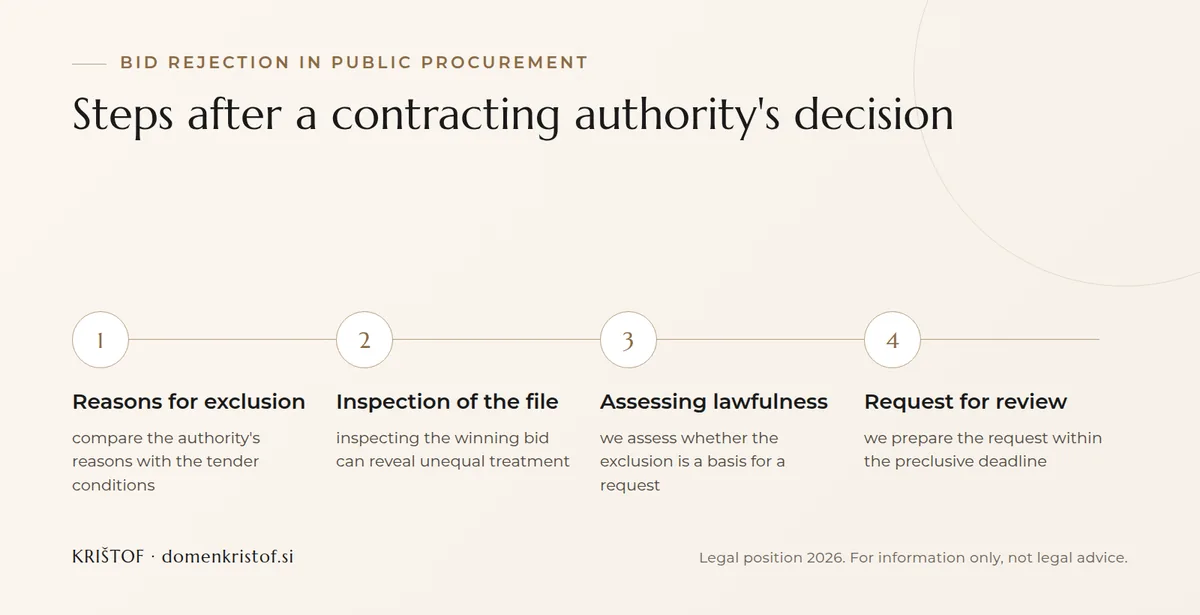
1) We read the reasons for the exclusion and compare them with the tender conditions. 2) Where necessary, we request inspection of the documentation and the selected bidder's bid (except protected information). This often reveals unequal treatment. 3) We assess whether the exclusion was lawful or is a basis for a request for review.
4) If justified, we prepare the request within the preclusive deadline (generally eight working days under the ZPVPJN). For formal deficiencies, we also check whether the contracting authority should have allowed them to be remedied, instead of excluding the bid.
The area falls under legal protection in public procurement and representation before the National Review Commission (DKOM).
Permissible supplementation and common mistakes
Not all deficiencies are the same. Some formal deficiencies the contracting authority must allow to be remedied (supplementing or clarifying the bid). Others, particularly those that would mean a change to the price or the substance of the bid, are not. If the contracting authority excluded the bid instead of allowing a permissible supplementation, this can be a basis for a request.
A common bidder mistake is not checking the decision through inspection of the file and missing the preclusive deadline. Where unlawfulness is suspected, we prepare a request for review as part of legal protection in public procurement.
Conditions for participation and technical requirements
Bids are most often excluded because of the conditions for participation (references, personnel, financial and technical capacity) or the technical requirements in the tender. What matters here is whether the conditions were proportionate and non-discriminatory. An overly strict or tailored condition can itself be unlawful.
That is why, on an exclusion, we check not only whether the bid meets the condition, but also whether the condition was permissible at all. If it was not, this is a basis for a request for review as part of legal protection.
What to prepare, and fast
Immediately gather: the contracting authority's decision with its reasoning, the tender documentation and your bid, and where necessary request inspection of the file. Because the deadlines are preclusive (generally eight working days), time is essential.
On this basis we assess lawfulness within the deadline and prepare any request for review, as part of legal protection.
Must the contracting authority explain why it excluded my bid?
Yes. The decision must be reasoned, and the bidder generally has the right to inspect the documentation of the procedure, except for protected information.
Can I supplement my bid if it is deficient?
It depends on the nature of the deficiency. Some formal deficiencies the contracting authority must allow to be remedied. Others (for example, changes to the price or the substance of the bid) generally not.
How long do I have to object?
The deadlines are short and preclusive (generally eight working days under the ZPVPJN). Once they expire, the right to challenge lapses, so you must act at once.
Is a request worthwhile if the price difference is large?
The assessment lies not in the price but in the lawfulness of the procedure. If the exclusion was unlawful or bidders were not treated equally, a request can be justified regardless of the difference.
Can I request inspection of a competitor's bid?
Generally yes, into the documentation of the procedure and the selected bidder's bid, except for trade secrets and protected personal data.
What if a price below the threshold was also excluded?
The contracting authority must check an abnormally low price under a procedure. If it did not deal with it properly, this can be a basis for a request. We assess this for the specific case.
Legal sources
Links point to official sources (PISRS and the competent institutions). This article is general information and is not a substitute for legal advice.