A request for review in public procurement: deadlines and procedure

A request for review is a bidder's legal remedy against breaches in a public procurement procedure, tied to short deadlines and the payment of a fee. We explain when to file it and what it must contain.
In public procurement, a bidder who believes the contracting authority has acted unlawfully has legal protection available. The central tool is a request for review under the Legal Protection in Public Procurement Procedures Act (ZPVPJN). One of the most important rules in this field applies here: the deadlines are short and preclusive. A delay means the loss of the right.
Below we explain when a request is possible, how the procedure works, and why acting quickly is essential.
When a request is possible
A request for review can be filed against the tender documentation (for example, unlawful or discriminatory conditions) and against a decision of the contracting authority (for example, on the award of the contract, the exclusion or the rejection of a bid). It may be filed by a bidder who shows a legal interest and the likelihood of loss.
It is important to challenge shortcomings in the tender documentation in good time. A later challenge to the same questions is generally no longer possible.
Deadlines: why they are decisive
The deadlines for filing a request are short and preclusive (under the ZPVPJN, generally eight working days from receipt of the notice or from publication, depending on the stage). Once the deadline expires, the right to challenge lapses, regardless of the merits of the objections.
That is precisely why, on receiving a contested decision, you must act at once. The review of the documentation, the assessment of the options and the preparation of the request must all be done within the deadline.
The pre-review and review procedures
A request is first dealt with in the pre-review procedure before the contracting authority, which may uphold or reject it. If it does not uphold it, the matter is referred to the National Review Commission (DKOM), which decides on the request in the review procedure. DKOM may annul unlawful acts of the contracting authority.
The procedure has its own formal rules (the content of the request, fees, evidence). A deficient or out-of-time request may be dismissed on procedural grounds.
What it is sensible to prepare
For a timely and effective request, the following are needed: the tender documentation, the contested decision of the contracting authority with its reasoning and your bid. On the basis of these we assess the options and prepare the request within the deadline.
Step by step, with attention to the deadlines
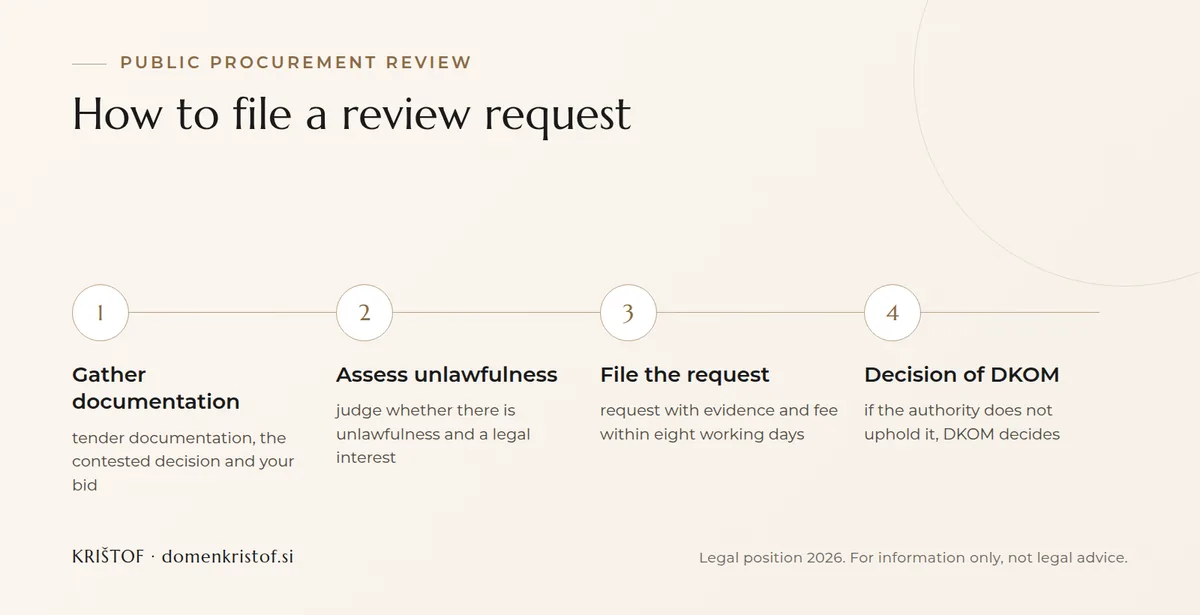
1) Immediately after the contested decision we gather the tender documentation, the contracting authority's decision with its reasoning, and our bid. Where necessary, we request inspection of the file. 2) Assessment: we judge whether there is unlawfulness (for example, unequal treatment, incorrect application of the criteria). 3) Request: we prepare and file the request, with evidence and payment of the fee, all within the preclusive deadline (under the ZPVPJN, generally eight working days).
4) Pre-review procedure: the contracting authority decides on the request first. 5) Review procedure before DKOM: if the contracting authority does not uphold it, the National Review Commission decides and may annul unlawful acts. Because the deadline runs quickly, a delay is irreparable, which is why acting fast is the essence of this field.
Where it is the decision on the bid itself that is contested, the topic connects with challenging the rejection of a bid. All of this falls under legal protection in public procurement.
Common bidder mistakes
The most common mistakes: reacting too late (a missed preclusive deadline), challenging the tender conditions only after submitting the bid (when they should have been challenged earlier), a deficient request, and overlooking inspection of the file, which would have revealed unequal treatment.
Another pitfall is filing a request without a realistic assessment of the prospects. A request must show unlawfulness and a legal interest. That is why, on receiving the decision, we first quickly assess the starting point and only then prepare the request. All of this falls under legal protection in public procurement and challenging the rejection of a bid.
What the National Review Commission can achieve
DKOM does not decide, in place of the contracting authority, who gets the contract, but it can annul unlawful acts (contested tender documentation, an unlawful decision on the award or on exclusion), and return the matter to the appropriate stage of the procedure.
The consequence of a successful request is therefore often a fresh, lawful conduct of part of the procedure, not an automatic award of the contract to the applicant. We set realistic expectations about the outcome at the assessment stage. All of this falls under legal protection in public procurement and challenging a rejection.
What to prepare, and fast
As soon as there is a contested decision, gather the tender documentation, the contracting authority's decision with its reasoning and your bid. Where necessary, request inspection of the file. The deadlines are short and preclusive, so days count.
On this basis we assess the options and prepare the request within the deadline, part of legal protection in public procurement.
What is the deadline for a request for review?
The deadlines are short and preclusive (under the ZPVPJN, generally eight working days, depending on the stage of the procedure). Once they expire, the right to challenge lapses. We assess the exact deadline for your case.
What can I file a request against?
Against the tender documentation (for example, discriminatory conditions) and against decisions of the contracting authority (the award, exclusion, rejection of a bid), if you show a legal interest and the likelihood of loss.
Who decides on the request?
First the contracting authority, in the pre-review procedure. If it does not uphold the request, the National Review Commission (DKOM), in the review procedure.
What should I prepare when there is a contested decision?
Immediately gather the tender documentation, the contracting authority's decision with its reasoning and your bid, and contact a lawyer within the deadline.
How much is the fee for a request for review?
The fee depends on the stage and the value of the contract and is prescribed by law. We check the specific amount when preparing the request.
Does a request suspend the conclusion of the contract with the selected bidder?
A filed request generally affects the possibility of concluding the contract until a decision is made. The effect depends on the stage and the circumstances, so timeliness is crucial.
Legal sources
- Legal Protection in Public Procurement Procedures Act (ZPVPJN), PISRS (in Slovenian)
- National Review Commission (DKOM)
- Public Procurement Act (ZJN-3), PISRS (in Slovenian)
Links point to official sources (PISRS and the competent institutions). This article is general information and is not a substitute for legal advice.