How to write a will: forms, conditions and common mistakes

A valid will can be holographic, written before witnesses, or notarial, each with its own conditions. We describe the forms, the most common mistakes, and when it is sensible to entrust the drawing-up of a will to a lawyer.
A will is one of the most powerful legal documents an individual has. With it you decide who will receive your estate. That is precisely why the law sets strict conditions of form for its validity. An error in form or content can lead to the challenge or invalidity of the will, which often triggers the very disputes the will was meant to prevent.
Below we explain the forms of will under the Inheritance Act (ZD), the conditions for validity, and the most common mistakes.
The forms of will
Slovenian law recognises several forms. The most common is the holographic will, which the testator must write entirely by hand and sign (a typed and merely signed document is not enough). Also common are the written will before witnesses (signed by hand in the presence of two witnesses) and the will made before a notary or a court.
In exceptional circumstances, the law also recognises special forms (for example, an oral will), but these are valid only under strict conditions and for a limited time.
The conditions for validity
For validity, the testator must have testamentary capacity (generally at least 15 years old and of sound judgement) and the will must be made freely and seriously, without coercion, threat or mistake. The formal requirements for the chosen type of will must also be observed.
It is precisely unmet formal requirements that are a common ground for challenge, so form is not a formality but a condition of validity.
Common mistakes
The most common mistakes are: a typed “holographic” will (which is not one), a missing or contested signature, unclear or contradictory provisions that allow more than one interpretation, and overlooking the compulsory share, on account of which the will has no effect in part. Also common is a will that does not cover the whole estate and leaves part to statutory succession.
Each of these mistakes can lead to a lengthy inheritance dispute.
The role of the compulsory share and safekeeping
Even a valid will cannot bypass the compulsory share of the closest relatives. It is sensible to design the will so that it anticipates the compulsory shares. It is also advisable to arrange for the safekeeping of the will (for example, with a notary, and entry in the register of wills), so that it is reliably found after death.
An example: a holographic will, step by step
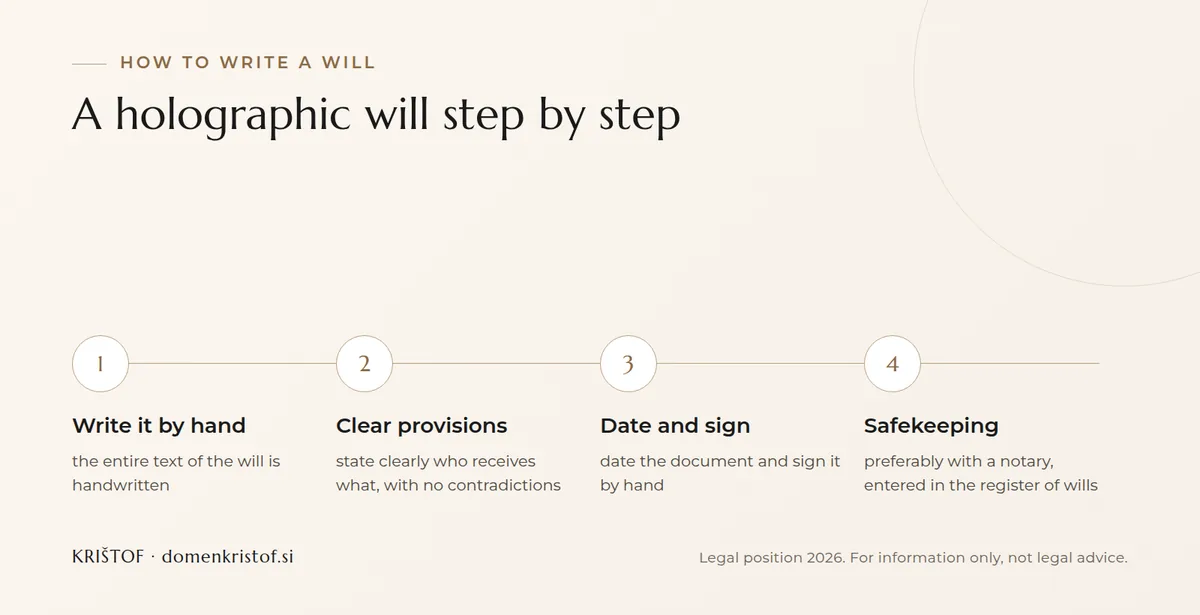
The simplest valid form is the holographic will. 1) You write the entire text by hand (not typed). 2) You state clearly who is to receive what, and avoid contradictory provisions. 3) You date and sign it by hand. 4) You arrange for safekeeping, preferably with a notary, with entry in the register of wills, so that it is reliably found after death.
Even a fully valid will cannot bypass the compulsory share of the closest relatives, so it is sensible to anticipate it. With a larger or more varied estate (a company, real estate), it is often better to choose the notarial form rather than a holographic one, as it gives additional security as to form and safekeeping.
Drawing up a will is part of inheritance planning, often connected with business succession.
Revoking and amending a will
You can revoke or amend a will at any time until death, by a new will, an express revocation or (for a holographic one) by destroying the document. As a rule, the last valid will applies, so it is important that an old one does not create ambiguity.
With a larger estate, we recommend reviewing the will regularly on major life changes (marriage, children, acquiring a company or real estate). To avoid disputes over authenticity and findability, safekeeping with a notary and entry in the register of wills is sensible, all as part of inheritance planning.
Other forms: the notarial, court and international will
Besides the holographic will and the written will before witnesses, the law also recognises the notarial and the court will, drawn up or confirmed by an official, which give greater security as to form, the testator's capacity and safekeeping.
For cases with a foreign element, there is also the international will, under special rules. With a larger or cross-border estate, the choice of form matters. We advise on it according to your situation, as part of inheritance planning.
What to prepare for the initial consultation
It helps to have: an overview of the estate (real estate, interests, accounts), a family picture (descendants, spouse, other close relatives) and your wishes regarding distribution and any specific legacies.
On this basis we propose the form and content of a will that takes the compulsory share into account and avoids later disputes, as part of inheritance planning.
Is a typed and signed will valid?
As a holographic will, no. That must be written entirely by hand. A typed text can be valid only in another form (for example, before witnesses or with a notary), where the conditions are met.
Do I need witnesses or a notary?
Not necessarily. A holographic will does not require witnesses. Witnesses are needed for a written will before witnesses. A notarial will, however, gives additional security as to form and safekeeping.
Can I amend a will at any time?
Yes. You can revoke or amend a will until death. As a rule, the last valid will applies.
How do I ensure that the will is found after death?
By safekeeping with a notary and entry in the register of wills. A holographic will kept at home may be overlooked or lost.
Can I write a will in a foreign language?
You can, if it meets the formal conditions and is comprehensible. With a foreign language, a translation is often required for implementation. We assess whether it is sensible for your case.
Is a joint will of spouses valid?
Slovenian law generally does not recognise a joint will. Each testator makes their own. The alignment of the two wills can be arranged separately.
Legal sources
- Inheritance Act (ZD), PISRS (in Slovenian)
- e-Uprava, state services portal
- European Commission, cross-border successions
Links point to official sources (PISRS and the competent institutions). This article is general information and is not a substitute for legal advice.