Wills and the compulsory share: how much of your estate can you really direct

The compulsory share protects the closest heirs even if a will leaves them out, and amounts to a portion of the statutory share of the estate. We explain who the compulsory heirs are, how much they are entitled to, and how the compulsory share is enforced.
A will allows you to decide the fate of your estate yourself, instead of statutory succession applying. But the freedom of testamentary disposition is not unlimited: Slovenian law (the Inheritance Act, ZD) protects the closest relatives with a compulsory share. Understanding how much of the estate is really “available” for free disposition is therefore a precondition for sensible planning.
Below we explain who the compulsory heirs are, how large the compulsory share is, and how it is enforced in practice.
Who the compulsory heirs are
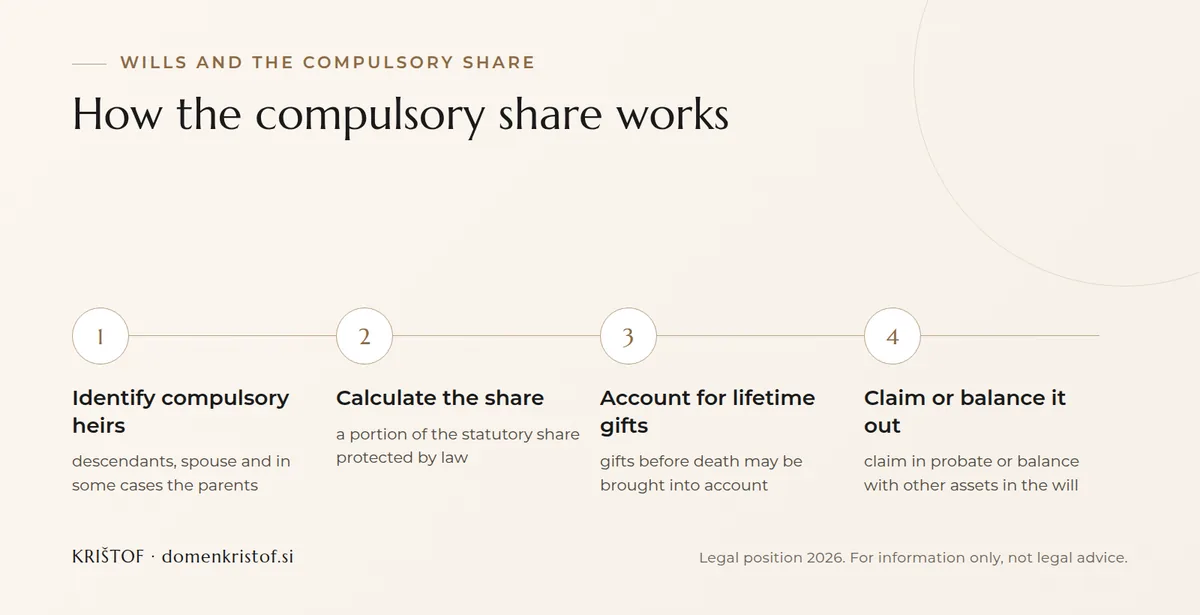
The circle of compulsory heirs is narrower than the circle of statutory heirs. The compulsory heirs generally include the deceased's descendants and spouse, and in certain cases also the parents (where descendants do not take priority). A compulsory heir is entitled to a compulsory share regardless of the content of the will.
If a will prejudices a compulsory heir, that heir is not automatically “erased”. They acquire the right to claim a compulsory share.
How large the compulsory share is
The compulsory share is a portion of the statutory share that the individual would receive under statutory succession. Under the ZD, it is one half for descendants and the spouse, and one third for certain other compulsory heirs, of their statutory share. The remainder, the so-called disposable portion, is what the testator may dispose of freely.
This means that a will cannot wholly disinherit the closest relatives, except in the exceptional, statutorily defined cases of disinheritance.
How the compulsory share is enforced
A compulsory heir must claim their compulsory share, generally in the probate proceedings or by a claim. If gifts were made before death, these may, to a certain extent, be brought into account against the estate when the compulsory share is calculated (bringing gifts into account), which often surprises both the recipients of the gifts and the other heirs.
Planning that takes the compulsory share into account
With a larger or more varied estate (a company, real estate), it is sensible to design the will so that it takes the compulsory shares into account and avoids later disputes, for example, by balancing out from other assets or with appropriate lifetime contracts (a transfer agreement, a lifelong-support contract). In this way the recipient of the company does not risk having to reach into it to pay out the compulsory shares.
An example: how the compulsory share is calculated
Suppose a deceased leaves everything to one child by will, although they have two children and a spouse. The other child and the spouse are compulsory heirs: their compulsory share is a portion of the statutory share (for descendants and the spouse, generally one half of what they would receive under statutory succession). To the extent that the will encroaches on the compulsory share, it has no effect.
To a certain extent, gifts made during life may be brought into account in the calculation, which often surprises the recipients. That is precisely why, when drawing up a will, we anticipate the compulsory shares and, where necessary, balance them out from other assets, so that the recipient of the company does not risk having to reach into it.
Planning that takes the compulsory share into account is part of wider inheritance and estate planning.
Disinheritance and deprivation of the compulsory share
The closest relatives can be wholly deprived only by disinheritance on statutorily defined grounds (for example, seriously offensive conduct towards the deceased) or by deprivation of the compulsory share in favour of descendants in special cases. The ground must be stated in the will and must exist.
Without the conditions being met, an attempt at disinheritance has no effect and the compulsory heir retains the right. That is why we carefully justify such decisions in law and include them in wider inheritance planning, connected with drawing up a will.
The order: the disposable portion and the compulsory share
An estate can be pictured in two parts: the disposable portion, of which the testator disposes freely, and the compulsory share, which is protected for the closest relatives. Legacies and gifts are first covered from the disposable portion.
Only if that does not suffice, and the compulsory share is encroached upon, may a compulsory heir seek a reduction of the testamentary dispositions or the return of gifts to the appropriate extent. That is precisely why, when drawing up a will, we calculate how much is actually available, as part of inheritance planning.
What to prepare for the initial consultation
It helps to have: an overview of the estate, a family picture (the compulsory heirs), information about larger gifts made during life, and your wishes regarding distribution.
On this basis we calculate the disposable portion and the compulsory shares and propose an arrangement that prevents disputes, as part of inheritance planning.
Can I leave someone out entirely with a will?
You can wholly deprive the closest relatives (the compulsory heirs) only by disinheritance on statutorily defined grounds. Otherwise they retain the right to a compulsory share.
How large is the compulsory share?
It is a portion of the statutory share: for descendants and the spouse generally one half, for certain other compulsory heirs one third of their statutory share.
Are gifts brought into account against the estate?
To a certain extent, yes. Gifts made before death may be taken into account when calculating the compulsory share (bringing gifts into account), which can affect the shares.
How do I prevent a dispute over the compulsory share?
With a will or lifetime contracts that anticipate the compulsory shares and, where necessary, balance them out from other assets. We assess the arrangement for your case.
Can someone waive their compulsory share in advance?
Under certain conditions, a waiver is possible (for example, by agreement), which is particularly useful when transferring a company. We assess the options for your case.
How is the estate valued for calculating the compulsory share?
By the value of the estate at death, taking into account gifts that are brought into account. For real estate and companies, an expert valuation is often required.
Legal sources
Links point to official sources (PISRS and the competent institutions). This article is general information and is not a substitute for legal advice.