Business loss and interruption: when damages are possible

Business loss, including lost profit, can be pursued, but it must be proved to a degree of likelihood and with documentation. We show what belongs in a claim and how the loss is calculated.
When a company suffers loss because of another's conduct (a breach of contract, a competitor's unlawful conduct or a contractual partner's error), it often turns out that proving the loss is harder than proving fault. The law of damages (the Obligations Code, OZ) recognises compensation for pecuniary loss, including lost profit, but under certain conditions.
Below we explain the legal bases, the types of business loss, and why proving the amount is often decisive.
The legal bases for damages
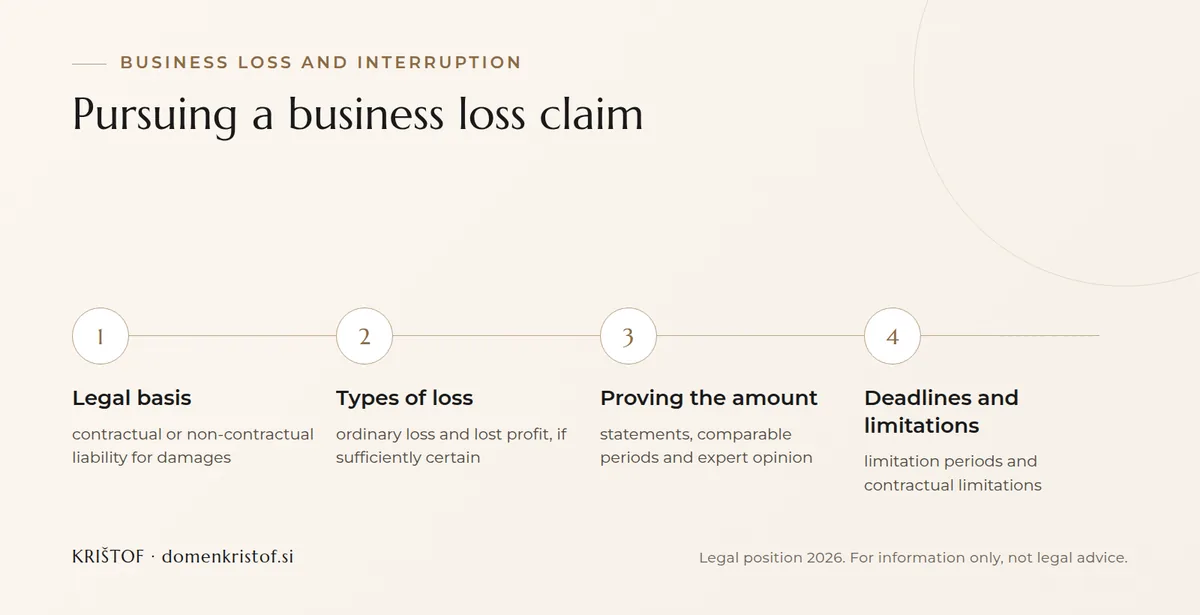
Liability for damages arises either from a breach of contract (contractual liability) or from unlawful conduct (non-contractual, tortious liability). In both cases one must generally show wrongful conduct, loss, a causal link between them, and the liability of the person who caused it.
For contractual liability, the starting point is often the contract itself (the obligation breached, the agreed consequences). For non-contractual liability, the general rules of the OZ.
The types of business loss
Business loss can comprise ordinary loss (actual outlays, damaged property) and lost profit (what the company would have earned had the harmful event not occurred). In business interruption it is often precisely lost profit that is in issue, for example, because of an interruption in supply, a loss of production or the loss of a contract.
The law recognises compensation for lost profit too, but only if it is sufficiently certain and foreseeable, not merely hypothetical.
Proving the amount of the loss
Proving the amount is, in practice, the central question. For lost profit, one must show with data (financial statements, comparable periods, orders that fell through) how much profit was realistically lost. An expert opinion is often required.
That is precisely why it is important to document the loss carefully as it occurs. A later reconstruction is harder and less convincing.
Deadlines and contractual limitations
Attention must be paid to the limitation periods for claims for damages and to any contractual limitations of liability (for example, agreed upper limits or the exclusion of lost profit), which can significantly restrict a claim. It is sensible to assess these provisions before pursuing a claim.
An example: proving business interruption
Suppose a supplier delays a key delivery and production stands still for a month. To obtain damages we must show wrongfulness, loss and causation. We prove the lost profit with data: comparable periods in previous years, orders we could not fulfil, the margins and the fixed costs that ran on despite the standstill.
In practice we often prepare a calculation with the accountant, supported by an expert opinion. The more the loss is documented as it happens (letters, complaints, a record of the interruption), the more convincing the claim. We also check whether the contract contains limitations of liability or a contractual penalty that change the starting point.
Where a debtor does not pay an awarded or undisputed loss, the matter continues with debt recovery. The whole falls within damages and commercial disputes.
What to watch for in contractual relationships
For loss arising from a contractual relationship, the starting point is the contract itself. It often contains limitations of liability, the exclusion of lost profit or a contractual penalty, all of which significantly change a claim. That is why we review the contract before assessing the prospects.
A timely complaint and notice of the loss also matter, since their omission can weaken the position. Where liability is established but the debtor does not pay, recovery follows. The area falls within damages.
Which types of loss can be pursued
The law distinguishes several types of loss. Ordinary loss is an actual reduction in assets (outlays, damaged property). Lost profit is the profit the injured party would realistically have achieved had the harmful event not occurred. In business interruption, it is often the central item.
In certain cases non-pecuniary loss is also possible, but for legal persons it is limited. Which type can be pursued, and to what extent, depends on the basis. We assess this for the specific case as part of damages.
What to prepare for the initial consultation
It helps to have: the contract or the basis of the relationship, documentation of the harmful event and the correspondence (complaints, reminders), and business data for calculating the loss (statements, comparable periods, orders that fell through).
On this basis we assess the basis, the type and the provable amount of the loss, and any contractual limitations of liability, part of damages and commercial disputes.
Can I claim lost profit?
Yes, if it is sufficiently certain and foreseeable and provable with data. Wholly hypothetical profit generally cannot be pursued.
How do I prove the amount of a business loss?
With business documentation (statements, comparable periods, orders that fell through), often with an expert opinion. Documenting the loss as it happens greatly eases the proof.
Does anything different apply on a breach of contract?
For contractual liability, the starting point is the contract (the obligation breached and the agreed consequences), so any contractual limitations of liability must also be checked.
By when can I pursue damages?
Until the limitation period expires, which differs according to the basis of the claim. We assess the start of the period and any interruption for your case.
Can I also claim fixed costs during a standstill?
Often yes, as part of the loss, if they arose despite the interruption and are a consequence of the harmful event. The extent must be proved with business documentation.
What if force majeure is to blame?
With force majeure, liability may be excluded or limited. Whether it is force majeure, and what the contract provides, we assess for the specific case.
Legal sources
Links point to official sources (PISRS and the competent institutions). This article is general information and is not a substitute for legal advice.