The sale and purchase agreement (SPA): the key clauses that protect buyer and seller

The sale and purchase agreement (SPA) governs the price, the warranties, the conditions precedent and the seller's liability. We explain the clauses that decide matters in practice, and what each side should watch for.
A sale and purchase agreement for a shareholding or a company (Share Purchase Agreement, SPA) is the document that translates the transaction into legally binding rules. The price is only one figure, the real allocation of risk is set by the clauses around it. Understanding these clauses matters to buyer and seller alike, because it is here that most later disputes arise.
Below we set out the clauses that, in practice, we review and negotiate most carefully.
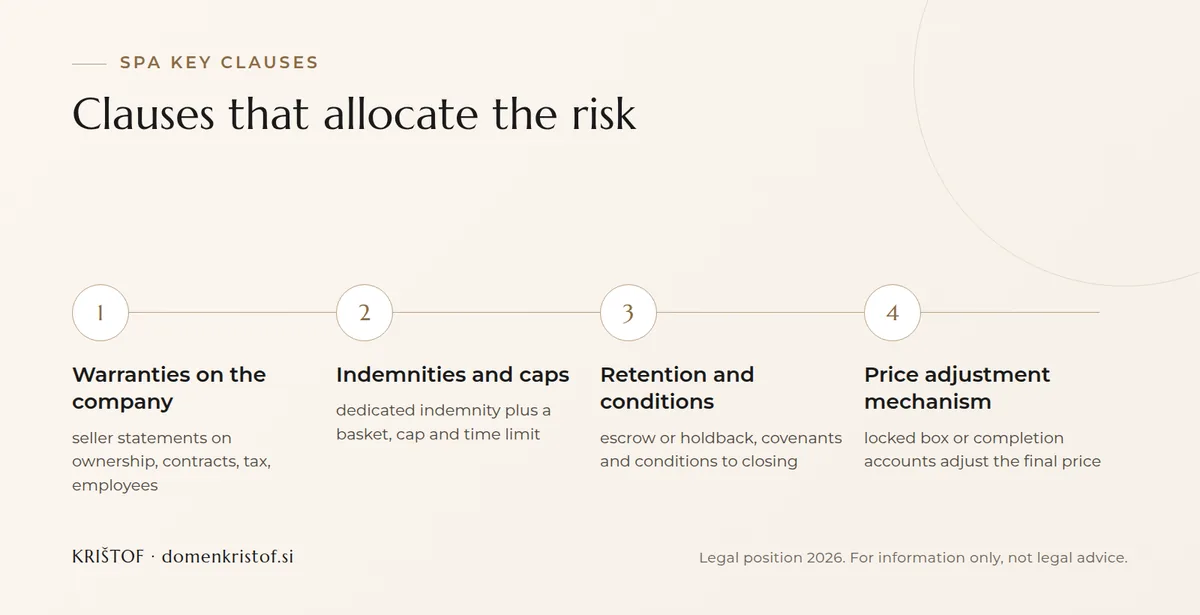
Representations and warranties
Representations and warranties are the seller's statements about the state of the company, about ownership of the shareholding, contracts, disputes, tax, employees and assets. If they prove untrue, the buyer generally has a claim for damages.
For the seller, it is essential that the warranties are limited to what it can genuinely confirm (often with the qualification “to the best of its knowledge”). For the buyer, that they cover the risks revealed by due diligence.
Indemnities and limitations of liability
For a known risk, a dedicated indemnity makes sense, compensating the buyer for a precisely defined loss regardless of the general warranties. Alongside this, limitations of liability are agreed: a minimum threshold for bringing claims (de minimis and basket), an upper limit (cap) and the periods within which claims may be brought.
These limitations are the heart of the negotiation: the seller wants a low cap and short time limits, the buyer the opposite. Without them, the seller's liability can remain open for too long and for too high an amount.
Retention of the purchase price, covenants and conditions to closing
A retention of part of the purchase price (holdback) or a deposit into an escrow account gives the buyer a source from which to satisfy any warranty claims. Covenants govern the seller's conduct between signing and closing, for example, that it carries on business as usual and does not take on major obligations.
Conditions precedent are events that must occur before the deal is completed (for example, consents, permits). If they are not met, closing does not take place.
The price mechanism and later adjustments
The price is often tied to the financial position at closing through an adjustment mechanism (locked box or completion accounts). It is also agreed how net debt and working capital are treated. An unclear price mechanism is a common source of post-closing disputes, so it is worth defining precisely.
An example: how the clauses work together
Suppose due diligence uncovers an unresolved tax dispute. In the SPA we deal with this through several linked clauses at once: the seller gives a warranty that there are no other such disputes. For the known dispute we add a dedicated indemnity, compensating the buyer for precisely that loss. And we retain part of the purchase price in escrow as a source of payment.
At the same time we set limitations of liability, a threshold (basket), an upper limit (cap) and a time limit for bringing claims, so that the seller's exposure is predictable. In this way a single review (see legal due diligence) allocates the risk between the parties through the agreement, instead of one side bearing it in full.
It is precisely the alignment of these clauses that separates a good agreement from a collection of standard provisions. That is why we prepare it as part of the whole transaction, not in isolation.
Governing law, jurisdiction and dispute resolution
Besides the substantive clauses, the SPA also determines the governing law and the method of dispute resolution, the ordinary courts or arbitration. For deals involving a Slovenian company, Slovenian law is usually appropriate. In cross-border deals, the choice of law and forum is an important decision with significant practical consequences for any dispute.
The language of the agreement and the relationship between several language versions are also agreed. If a dispute does arise, its course depends precisely on these provisions, so we treat them as part of managing the risk of a dispute, not as a formality at the end.
Covenants up to closing and the material adverse change (MAC) condition
Between signing and closing (where they are not simultaneous), the SPA uses covenants to govern the seller's conduct: that it carries on business as usual, does not take on major obligations and does not dispose of assets. This ensures the buyer receives the company in the state it expected.
A material adverse change (MAC) clause is also common, allowing the buyer to walk away if a serious negative event occurs before closing. The scope of these provisions is a matter for negotiation, and we align it with the findings of the review.
What is the difference between a warranty and an indemnity?
A warranty is a statement about the state of the company. On a breach, loss must be proved. An indemnity covers a precisely defined known risk in advance, often without having to prove general loss.
What are a cap and a basket?
A cap is the upper limit of the seller's liability. A basket is the threshold that claims must exceed before they can be brought. Both allocate risk between buyer and seller.
Is escrow essential?
It is not essential, but it is common where the buyer wants a reliable source from which to satisfy warranty claims. The alternatives are a retention of part of the purchase price or a bank guarantee.
Which law should govern the SPA?
For deals involving a Slovenian company, Slovenian law is usually appropriate. In cross-border deals, the choice of law and of the competent court or arbitration is a matter for agreement, with significant consequences.
How long should the period for bringing warranty claims be?
It depends on the type of warranty. General ones are often 12 to 24 months, while tax and certain others run longer (tied to limitation periods). The periods are a matter for negotiation and we adapt them to the deal.
Is a template agreement enough?
A template can be a starting point, but the allocation of risk differs for every deal. Without adapting the warranties and limitations of liability, a template often protects the wrong side.
Legal sources
Links point to official sources (PISRS and the competent institutions). This article is general information and is not a substitute for legal advice.