Debt recovery: out of court, enforcement or a lawsuit?

You can recover a claim out of court, by enforcement based on an authentic document, or by a lawsuit. We show when each route makes sense, depending on the size of the claim, the evidence and the debtor's ability to pay.
An unpaid claim is not just an accounting entry. It is a question of liquidity, and often a test of how seriously a company defends its rights. In debt recovery, acting in good time and with judgement is essential: the right route depends on whether the claim is undisputed, whether the debtor acknowledges it, and what their ability to pay is.
Below we set out the main routes to recovery and the criteria for choosing between them.
Out-of-court recovery
The first step is usually a demand letter and an attempt at an out-of-court arrangement: an agreement on payment, an instalment plan or an acknowledgement of the debt. This route is the fastest and cheapest, and makes sense above all where the debtor acknowledges the claim and is able to pay.
Even at this stage it is important to act so as to preserve the evidentiary position for any further steps (for example, a written acknowledgement of the debt).
Enforcement based on an authentic document
Where a claim is based on an authentic document (for example, an invoice, a statement of account, a bill of exchange), an application for enforcement can be filed through the electronic procedure (COVL). The court issues an enforcement order. If the debtor does not object, the order becomes enforceable and recovery follows (for example, attachment of accounts or assets).
This route is fast and effective for undisputed monetary claims. If the debtor objects on justified grounds, the procedure continues as litigation.
A lawsuit and litigation
Where a claim is disputed (the debtor challenges it on its basis or amount), a lawsuit and proof before the court are required. The procedure is longer, but it is the only route to an enforcement title for disputed claims. Here too, before filing, it is sensible to assess the evidence and the debtor's ability to pay realistically.
Limitation and securing the claim
In debt recovery, attention must be paid to the limitation periods (the general one under the Obligations Code is five years, for some claims it is shorter). A time-barred claim is legally difficult to enforce. Where there is a risk that the debtor will dispose of assets, an interim order can be sought to secure the claim, even before or during the procedure.
Step by step: from demand letter to enforcement
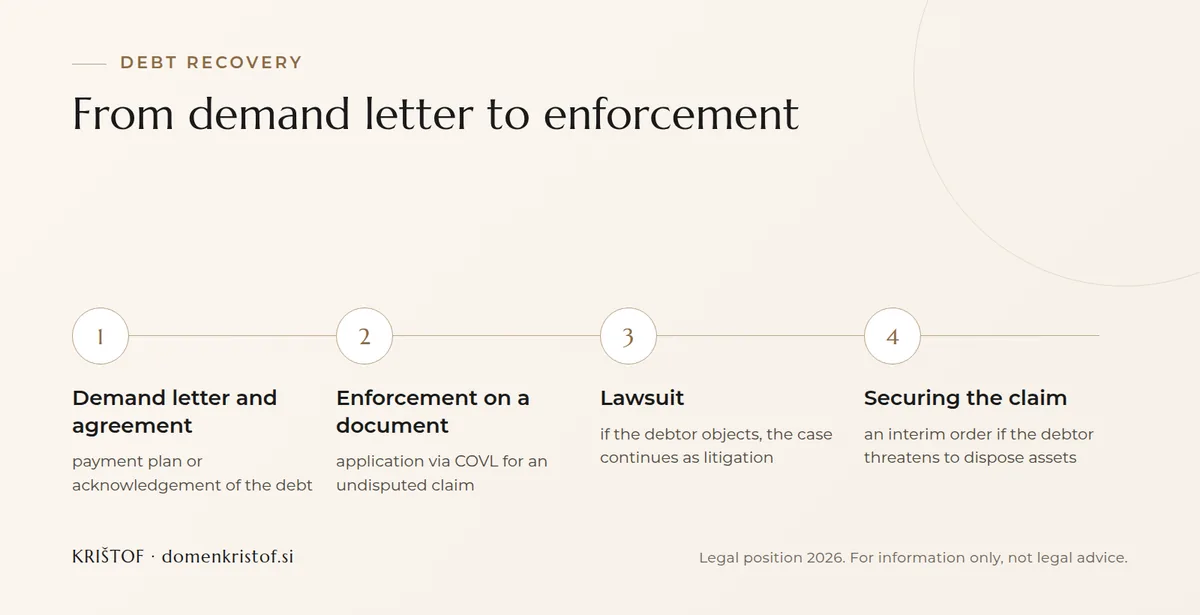
Effective recovery proceeds in stages. 1) Demand letter and agreement: a written demand, ideally with a proposal for instalment payment or acknowledgement of the debt, the fastest and cheapest route where the debtor is able to pay. 2) Enforcement based on an authentic document: for an undisputed monetary claim we file an application (electronically, via COVL). Absent an objection, the order becomes enforceable and attachment follows.
3) Lawsuit: if the debtor objects on justified grounds, the procedure continues as litigation and proof is required. 4) Security: where there is a threat that the debtor will dispose of assets, we seek an interim order. Throughout, we watch the limitation periods (the general one under the OZ is five years).
Where a claim arises from business loss, the route connects with pursuing business losses. Disputed claims fall within commercial disputes.
Costs and whether recovery is worthwhile
Before acting, we realistically assess the debtor's ability to pay and whether it is worthwhile in cost terms. For an undisputed claim, enforcement based on an authentic document is fast and cost-effective, and the costs are generally borne by the debtor on success. For a disputed claim, the risk of litigation must also be taken into account.
Where the debtor currently has no assets, it is sometimes sensible at least to secure the claim or obtain an enforcement title for later. For claims arising from business loss, the route connects with proving the loss. All of this falls within commercial disputes.
What if the debtor becomes insolvent
Where a debtor falls into insolvency (bankruptcy or compulsory composition), individual recovery is generally no longer possible. The claim must be filed in the proceedings in good time, within the prescribed deadline, or it may lapse. The deadlines are short and must be monitored.
A creditor's position depends on the type of claim (for example, secured by a mortgage or unsecured) and the order of priority for payment. That is why, at the first signs of the debtor's inability to pay, we act quickly. The area falls within commercial disputes and claims arising from loss.
What to prepare for the initial consultation
It helps to have: the basis of the claim (the contract, the order, the invoices), evidence of delivery or of the service provided, correspondence with the debtor, and information about the debtor, together with any acknowledgement of the debt.
On this basis we assess whether the claim is undisputed, which route to recovery is most appropriate, and whether securing the claim makes sense, part of commercial disputes.
When does enforcement make sense and when a lawsuit?
Enforcement based on an authentic document makes sense for undisputed monetary claims. If the debtor objects on justified grounds, or the claim is disputed, a lawsuit is required.
How do I know whether a claim is time-barred?
Under the Obligations Code, the general limitation period is five years. For some claims it is shorter. The start and interruption of the period must be assessed for the specific case.
Is it worth recovering if the debtor has no assets?
Before acting, it is sensible to assess the ability to pay. Even then, it is sometimes possible to secure the claim in case the debtor acquires assets later.
Can I secure a claim before judgment?
Yes, by an application for an interim order, where there is a risk that the debtor would dispose of or hide assets. The conditions for an order are assessed in each case.
How much does recovery through enforcement cost?
A court fee is payable, and the reimbursement of costs is generally borne by the debtor on success. Before acting, we assess whether it is worthwhile in cost terms, given the debtor's ability to pay.
What is an authentic document?
A document that evidences a claim (for example, an invoice, an extract from the business books, a bill of exchange). It allows faster enforcement without prior litigation, if the debtor does not object.
Legal sources
- Enforcement and Securing of Claims Act (ZIZ), PISRS (in Slovenian)
- e-Sodstvo portal (land register, enforcement)
Links point to official sources (PISRS and the competent institutions). This article is general information and is not a substitute for legal advice.