Inheritance without a will: the statutory orders of succession and common disputes

Without a will, the estate passes to the statutory line of succession: first the spouse and the children in equal shares. This article explains the orders of succession, the most common disputes, and when it is worth arranging inheritance in advance.
Where a deceased leaves no (valid) will, statutory succession applies: the estate is divided according to the rules of the Inheritance Act (ZD), not according to the deceased's wishes. Many people assume that “everything goes to the spouse” or “half to the children”, but the rules are more precise and often different from expectations, which is also a common source of disagreement.
Below we explain the orders of succession, the shares, and why disputes so often arise precisely in inheritance without a will.
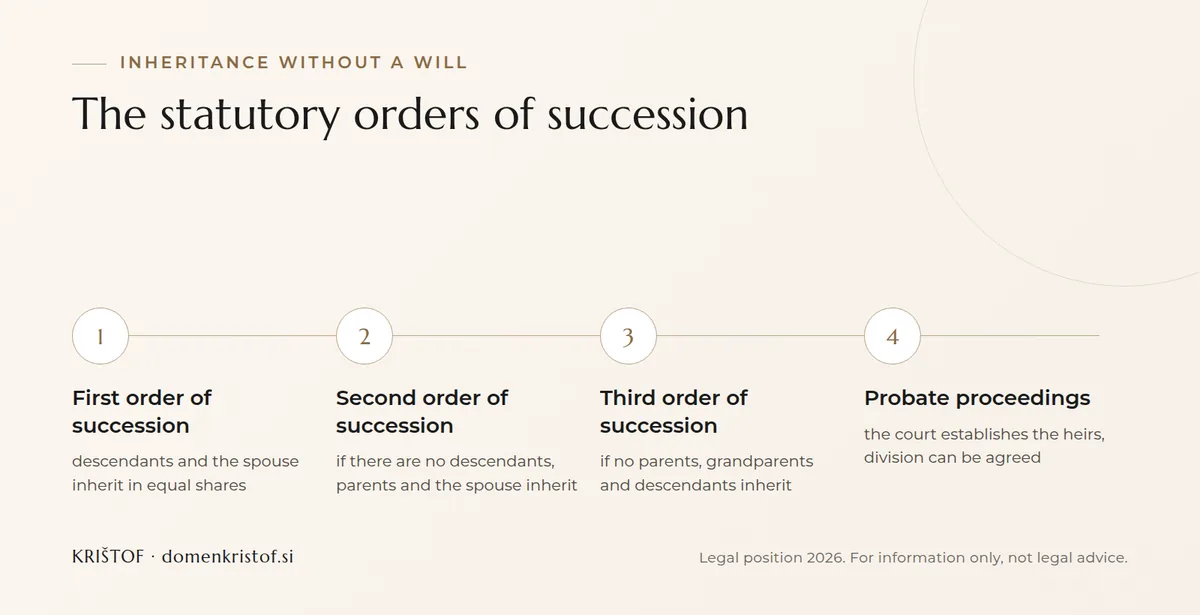
The orders of succession
Statutory succession proceeds by orders of succession. The first order comprises the deceased's descendants and spouse. They inherit before all others. If there are no descendants, the second order applies (the deceased's parents and spouse), and then the third (grandparents and their descendants).
A nearer order excludes a more distant one: as long as there are heirs of the first order, heirs of the second do not inherit.
The shares of the spouse and descendants
In the first order, the estate is generally divided into equal shares between the spouse and the children. So if there is one child alongside the spouse, each inherits one half. If there are two children, the spouse and each child inherit one third, and so on. Here, the inherited estate must be distinguished from any joint property of the spouses, which is divided first.
It is precisely the mixing of joint property and the estate that is a common source of confusion in calculating the shares.
Why disputes arise
Disputes most often arise because of an unclear composition of the estate (what actually belongs to it), because of gifts made during life (and the question of bringing them into account), because of real estate in co-ownership, and because of the differing expectations of the heirs. Without a will, there is no expression of the deceased's wishes to resolve many a question in advance.
The role of probate proceedings
Inheritance is dealt with in probate proceedings, in which the court establishes the heirs, the estate and the inheritance rights. In them, the heirs may conclude an agreement on division, which often suits their interests better than the statutory division into notional shares (for example, one heir takes the real estate while another receives a payment). A well-prepared agreement prevents prolonged co-ownership and disputes.
An example: who inherits when there is no will
Suppose the deceased leaves a spouse and two children, with no will. Under the first order they inherit together, generally in equal shares, each one third of the estate. Before that, the spouse's share is first separated out of the spouses' joint property, which is not part of the estate. It is precisely this mixing of joint property and the estate that is a common source of confusion.
If there were no descendants, the second order would apply (parents and spouse), and so on. In the probate proceedings, the heirs may conclude an agreement on division, for example, one heir takes the real estate while another receives a payment, which is often better than co-ownership in notional shares.
So that the estate is not divided by law against your wishes, a will is sensible, as part of inheritance planning.
Bringing gifts into account, and special features
In statutory succession, gifts that the deceased made to heirs during life are, to a certain extent, brought into account in calculating the shares, otherwise the recipient would be twice better off. This often comes as a surprise and is a source of disputes, so for an estate with larger gifts legal assistance is sensible.
Special features also apply to a cohabiting partnership (equated with marriage where the conditions are met) and to real estate in co-ownership. So that the estate is not divided against your wishes, the solution is a will. We conduct contested estates in the probate proceedings.
The second and third orders of succession
If the deceased has no descendants, the second order applies: the deceased's parents and spouse inherit (the spouse generally one half, the parents the other half). If there are neither descendants nor parents (or their descendants), the third order follows: grandparents and their descendants.
A nearer order always excludes a more distant one. The rules are precise and often different from expectations, so with a non-standard family picture it is sensible to check who actually inherits, or to arrange this in advance with a will.
What to prepare for the initial consultation
It helps to have: details of the deceased and the relatives (descendants, spouse, parents), an overview of the assets and debts, and information about larger gifts and any joint property of the spouses.
On this basis we explain who inherits and in what shares, and prepare any agreement on division in the probate proceedings.
Does the spouse inherit everything if there is no will?
As a rule, no. In the first order, the spouse inherits together with the descendants, usually in equal shares. Only if there are no descendants do the further orders of succession apply.
How are the shares divided between the spouse and the children?
In the first order, generally in equal shares. Here, any joint property of the spouses is first separated from the estate.
Are gifts taken into account even without a will?
They can be. In calculating the shares and the compulsory shares, gifts made during life are taken into account to a certain extent.
Can the heirs divide the estate differently from what the law provides?
Yes. In the probate proceedings they may conclude an agreement on division that suits their interests, instead of a division into notional shares.
Does a cohabiting partner inherit without a will?
For inheritance, a cohabiting partnership is equated with marriage under certain conditions. Meeting the conditions must be proved. We assess the details for your case.
What about inheriting debts?
An heir is liable for the deceased's debts up to the value of the inherited estate. That is why, before the declaration of inheritance, it is important to know the composition of the estate.
Legal sources
- Inheritance Act (ZD), PISRS (in Slovenian)
- e-Uprava, state services portal
- European Commission, cross-border successions
Links point to official sources (PISRS and the competent institutions). This article is general information and is not a substitute for legal advice.