Probate proceedings: how they work and how to avoid complications

Probate proceedings are conducted by the court, and in them the heirs arrange the transfer of the deceased's estate. We describe how they proceed, the roles of the participants, and how disagreements between heirs are resolved.
Although the estate passes to the heirs by operation of law at the moment of death, the court establishes the heirs, the estate and the inheritance rights in probate proceedings. For many people this is their first encounter with a court, often in an emotionally difficult period. Understanding how the proceedings work, and timely decisions (especially on accepting or renouncing the inheritance), help the proceedings to run calmly and without unnecessary complications.
Below we explain the main steps, the role of the declaration of inheritance and the agreement on division, and the common pitfalls.
How the proceedings begin
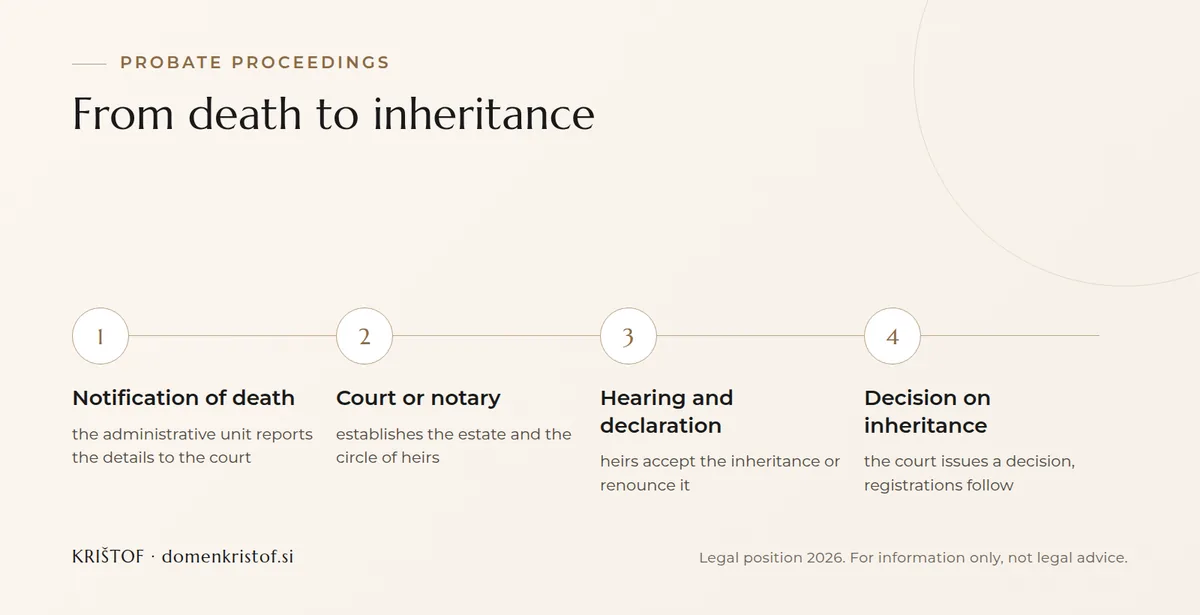
The proceedings begin on the basis of a notification of death, sent by the administrative unit (the registrar). The local court of the deceased's last permanent residence has jurisdiction. The court (often through a notary acting as court commissioner) establishes the composition of the estate and the circle of heirs and schedules a probate hearing.
The declaration of inheritance: acceptance or renunciation
At the hearing, the heirs give a declaration of inheritance, whether they accept the inheritance or renounce it. This is an important decision: with an inheritance one generally also takes on the deceased's debts (up to the value of the inherited estate). If the estate is over-indebted, renunciation may make sense.
Renunciation also applies to the descendants of the person renouncing, unless the declaration states otherwise, so the consequences must be carefully considered.
The agreement on division
Where there are several heirs, they may conclude an agreement on the division of the estate, instead of each remaining a co-owner of everything in notional shares. In this way, for example, one heir takes the real estate while another receives a payment. A good agreement prevents prolonged co-ownership, which is a common source of later disputes.
Common pitfalls
The most common complications: a dispute over the composition of the estate (what belongs to it, the question of the spouses' joint property), unknown or contested heirs, gifts and compulsory shares, and real estate abroad. Many a complication can be anticipated and prepared for in advance, with documentation in order and a clear will made during life.
Step by step: how the hearing proceeds
1) Notification of death: the administrative unit reports the details of the deceased and the heirs to the court. 2) Court/notary: the competent local court (often through a notary acting as court commissioner) establishes the composition of the estate and the circle of heirs. 3) Hearing: the heirs give a declaration of inheritance, accepting the inheritance or renouncing it.
4) Agreement on division: where there are several heirs, they may agree on a specific division instead of notional shares. 5) Decision on inheritance: the court issues a decision, on the basis of which ownership is registered (for example, real estate in the Land Register). Where there are complications (contested heirs, gifts, real estate abroad), legal assistance before the hearing makes sense.
Probate proceedings are the concluding part of inheritance and succession. Many a complication is prevented by a will made in advance.
Special cases and advice
Complications are caused above all by unknown or non-resident heirs, real estate abroad (which may require proceedings under foreign law), a contested composition of the estate, and an over-indebted estate, where renunciation of the inheritance must be considered.
Advice: before the hearing, gather documentation on the assets and debts and any gifts, so that the division is clear. In disputes, legal advice before the hearing is sensible. We conduct the proceedings as part of inheritance and succession.
After the decision on inheritance: registrations and implementation
With the issue of the decision on inheritance, the proceedings are not necessarily complete in practice. On its basis, the registrations are carried out (real estate in the Land Register, interests in the court register), and the deceased's bank accounts and other relationships are settled.
Where the heirs have concluded an agreement on division (for example, one takes the real estate, another a payment), this is implemented after the decision. For complex estates, monitoring the implementation makes sense. All of this falls within inheritance and succession.
What to prepare for the initial consultation
For a quick assessment of the matter, the following are useful: basic details of the deceased and the heirs, any will, an overview of the assets (real estate, accounts, interests, vehicles) and debts, and information about larger gifts made during life. If proceedings are already under way, bring the court or notarial documentation received.
On this basis we assess how the proceedings will run, any complications and whether an agreement on division makes sense, all as part of inheritance and succession.
Do I have to accept the inheritance?
No. You can accept it or renounce it. Because an inheritance also brings the debts (up to the value of the estate), renunciation may make sense for an over-indebted estate.
Do I also take on the debts with the inheritance?
As a rule, yes, an heir is liable for the deceased's debts up to the value of the inherited estate. That is why it is important to know the composition of the estate before the declaration.
Who conducts the proceedings?
The local court of the deceased's last residence, often through a notary acting as court commissioner.
Can the heirs divide the estate by agreement?
Yes. An agreement on division allows you to divide the estate according to your interests, instead of co-ownership in notional shares.
How long do probate proceedings take?
For undisputed matters, generally a few months. With disputes or a complex estate, longer. Documentation in order speeds up the proceedings.
Do I have to attend the probate hearing?
It is advisable, but you may be represented by an authorised representative. A declaration of inheritance can also be given through a representative with an appropriate power of attorney.
Legal sources
- Inheritance Act (ZD), PISRS (in Slovenian)
- e-Uprava, state services portal
- European Commission, cross-border successions
Links point to official sources (PISRS and the competent institutions). This article is general information and is not a substitute for legal advice.