The insurer has rejected your claim for damages: what you can do

A rejection of a claim by the insurer is not necessarily final. It often rests on incomplete evidence or a narrow reading of the cover. We show how to check and challenge a rejection.
A rejection or an undervaluation of a claim for damages is not necessarily the end of the road. In a dispute, the insurer is the opposing party, with its own interest. Its first assessment is not a final judgment. The real question is not just “am I entitled to compensation”, but “will I receive as much as I am actually entitled to, and how do I prove it”.
Below we set out the steps after a rejection and how to prepare a well-founded objection.
First: the reason for the rejection
The first step is to understand why the claim was rejected or reduced. The reasons vary: allegedly unmet conditions in the policy, exclusions from cover, a dispute over the cause or extent of the loss, or a low assessment by the loss adjuster. The insurer is obliged to give reasons for its decision. Those reasons are the starting point for an objection.
It is also sensible to check the terms of the policy and the general terms and conditions, which the parties often do not read in full detail.
An objection and additional evidence
A rejection can be appealed, or an objection filed, supported by additional evidence: your own assessment, medical or expert documentation, photographs and witnesses. It is often precisely an independent assessment that shows the original valuation to have been too low.
A well-prepared objection with evidence often leads to a fresh, higher assessment even before any court proceedings.
Litigation and deadlines
If agreement is not possible, a lawsuit against the insurer is available. Here it is essential to watch the deadlines, both contractual (from the policy) and the limitation periods for claims for damages, which in insurance relationships can be shorter. A missed deadline can defeat the claim for good.
Common types of dispute
In practice, disputes revolve around the amount of compensation (especially for non-pecuniary damage and long-term consequences), causation (whether the loss really is a consequence of the insured event) and exclusions in the policy. Each type calls for its own preparation of the evidence.
Step by step: after receiving a rejection
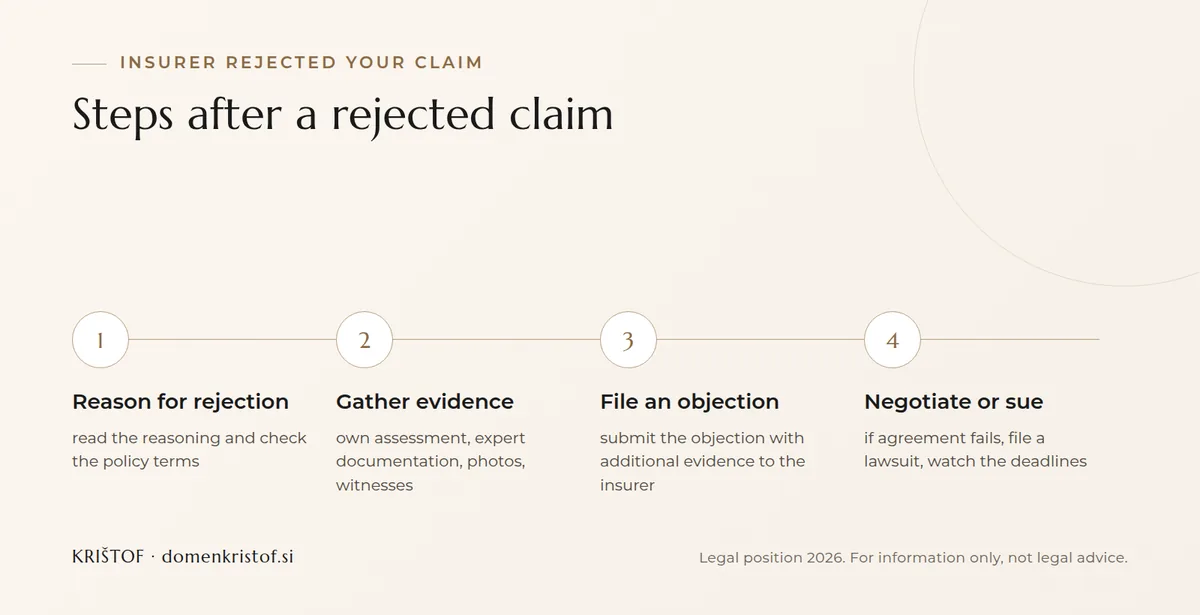
1) We read the reasons and the policy: we establish the exact reason (an unmet condition, an exclusion, a dispute over the cause or the amount) and check the general terms and conditions. 2) We gather evidence: our own assessment, medical or expert documentation, photographs, witnesses. 3) We file an objection with additional evidence. This often already leads to a higher offer.
4) Negotiations or a lawsuit: if agreement is not possible, we file a lawsuit. Throughout, we watch the deadlines, both the limitation periods and those from the policy, which are sometimes shorter. In disputes over the amount, it is often the proven amount of the loss that is decisive.
Disputes with insurers fall within damages and insurance disputes. Where intellectual property rights are infringed, damages for copyright infringement are also connected.
Common grounds for rejection and how to address them
The most common grounds: an allegedly unmet condition in the policy, an exclusion from cover, a dispute over causation (whether the loss really is a consequence of the insured event) and a low assessment. We address each differently, by interpreting the policy, with additional evidence, or with an independent assessment.
For non-pecuniary damage (bodily injuries, consequences), it is often the amount that is disputed. Here medical and expert documentation is decisive. We conduct disputes as part of damages and insurance disputes, observing the deadlines in good time.
Typical points of dispute by type of insurance
The points of dispute differ by type of insurance. With property insurance, a dispute over the extent of cover and the amount of the loss is common. With motor and liability insurance, over fault and causation. With accident and health insurance, over the definition of the event and permanent consequences.
In every case, the documentation at the time the event occurred is crucial. Where the amount is disputed, an independent assessment or an expert opinion is often decisive. We conduct disputes as part of damages and insurance disputes.
What to prepare for the initial consultation
It is useful to bring: the insurance policy and the general terms and conditions, the decision rejecting the claim or the insurer's assessment, documentation of the loss event (the report, photographs, medical or expert reports) and any correspondence.
On this basis we assess the reason for the rejection and the prospects of an objection, and the realistic amount of the claim, as part of damages and insurance disputes.
Is it worth objecting to a rejection?
Often yes, especially if the assessment rests on incomplete evidence or a low valuation. An independent assessment and additional evidence can lead to a higher assessment.
What deadlines apply?
Besides the limitation periods for damages, the policy may set its own deadlines for notification and objection, which are sometimes shorter. The deadlines must be checked immediately on a rejection.
Do I need my own assessor?
Often it is helpful. An independent assessment is a strong counter-argument to the insurer's first assessment, especially in disputes over the amount of the loss.
When does a lawsuit make sense?
When agreement is not possible and the evidence supports a higher claim. Before suing, we realistically assess the evidence, the amount and the cost risk.
Is an objection to the insurer mandatory before a lawsuit?
It is not always mandatory, but it is often sensible. With additional evidence, many a dispute is resolved without going to court. We adapt the approach to the reason for the rejection and the deadlines.
Who pays for the independent assessment?
Generally the person commissioning it (the injured party), but on success the cost can be part of the claim for damages or the litigation claim. We assess whether it is sensible, given the amount in dispute.
Legal sources
Links point to official sources (PISRS and the competent institutions). This article is general information and is not a substitute for legal advice.