Setting up a company in Slovenia: a foreigner's guide

A foreign person can set up a limited liability company (d.o.o.) in Slovenia. The process requires identification, share capital of EUR 7,500 and entry in the register. We explain the steps and the documents you will need.
Foreign companies and individuals may establish a company in Slovenia, but the steps and the timeline often differ from what they are used to at home. The good news is that Slovenia is relatively accessible for foreign founders, especially for EU citizens. That said, there are a few requirements (a tax number, a notary, registration) that are best arranged in the right order.
Below we set out the main steps for foreign founders. We also run and document the process in English.
Choosing the legal form
The most common form is a limited liability company (d.o.o.), which limits liability to the capital contributed. The alternatives are a branch of a foreign company (not a separate legal entity) and a representative office (without commercial activity). Each form has different consequences for liability, taxation and obligations.
Tax number and registrations
A foreign founder (an individual or a company) will, as a rule, need a Slovenian tax number (FURS), and often other basic registrations as well, depending on the activity. It makes sense to complete these steps before or at the time of incorporation, so that the process runs without delays.
Notary and entry in the court register
The instrument of incorporation (the articles of association or the deed of incorporation) is settled with a notary, followed by payment of the share capital and entry in the court register, by which the company comes into existence. For foreign founders, appropriate identification must be arranged and, where necessary, translations and certifications of documents.
What is worth knowing in advance
Procedures that are routine elsewhere have their own particularities in Slovenia, from requirements regarding a representative to the bank account and beneficial owners (entry in the register of beneficial owners). Local legal support saves time and prevents mistakes that would otherwise require corrections after incorporation.
Step by step: setting up a d.o.o. for a foreign founder
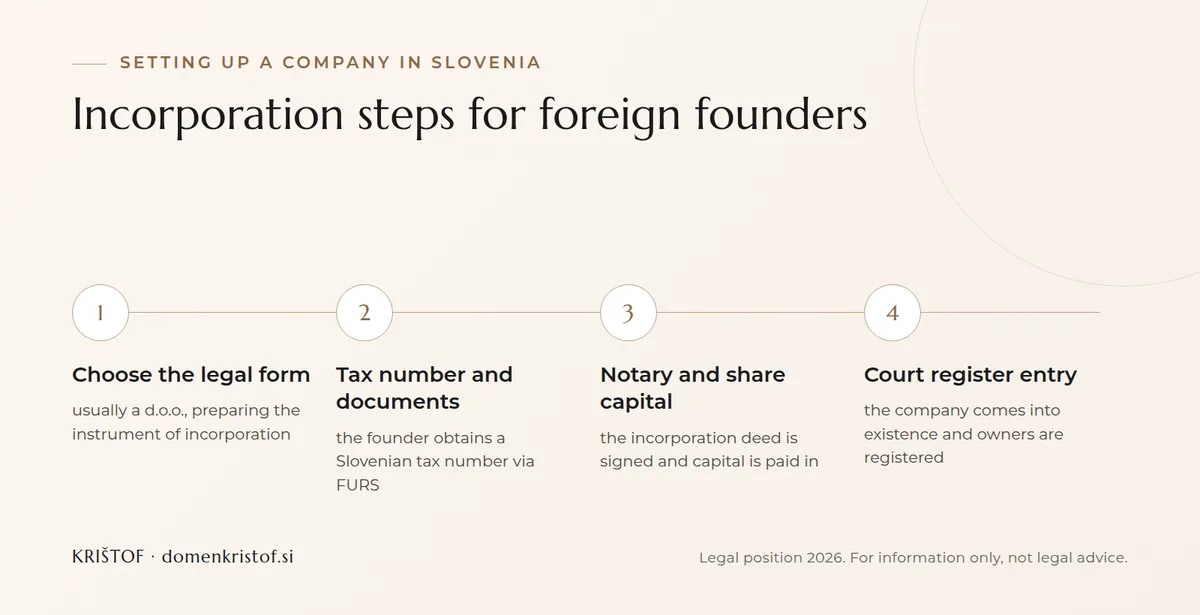
1) We choose the form (most often a d.o.o.) and prepare the instrument of incorporation. 2) The foreign founder obtains a Slovenian tax number (FURS). Where needed, we arrange translations and certifications of documents. 3) We carry out the procedure before a notary and pay in the share capital. 4) This is followed by entry in the court register, by which the company comes into existence, and entry in the register of beneficial owners.
Much can be arranged through an authorised representative, without a permanent presence in Slovenia. We run and document the process in English, so that at every stage the founder understands what they are signing. After incorporation, the purchase of business premises or equipment often follows, which connects to buying property as a foreigner.
This service falls under legal support for foreign clients and corporate restructurings.
After incorporation: bank account, taxes, compliance
After incorporation, practical steps follow: opening a business account (banks have their own requirements regarding foreign owners and beneficial owners), tax registrations depending on the activity (for example VAT) and ongoing compliance (accounting, reporting, the register of beneficial owners).
The question of the representative and the registered office is also important, as are any permits for particular activities. We arrange and monitor all of this in English, often together with the purchase of business premises, as part of support for foreign clients.
Forms of presence: company, branch, representative office
A foreign company has several options for a presence in Slovenia. A d.o.o. is a separate legal entity with limited liability and the most common choice. A branch is not a separate legal entity. It operates in the name of the foreign parent company, which is liable for its obligations.
A representative office is intended for non-commercial, preparatory activities (for example market research). The choice affects liability, taxation and the scope of permitted activities. We advise on it in light of your goals, as part of support for foreign clients.
What to prepare
Useful at the outset: identification documents of the founder(s) and any corporate documents of a foreign parent (with translations where needed), the intended business activity and company name, the planned ownership structure and the data of beneficial owners.
On this basis we propose the right form and a step-by-step plan, and handle the process in English as part of support for foreign clients.
Can a foreigner own a company in Slovenia?
Yes. Foreign citizens and companies may establish and own a company in Slovenia. For EU citizens the process is, as a rule, equivalent to the domestic one. We also advise and document in English.
Which form is the most common?
A limited liability company (d.o.o.). The alternatives are a branch and a representative office, which have different consequences for liability and activities.
Do I need a Slovenian tax number?
As a rule, yes. A foreign founder needs a Slovenian tax number (FURS), and often other registrations as well, depending on the activity.
Do I have to be present in person?
Much can be arranged through an authorised representative and with appropriately certified documents. We check the specific requirements in light of your situation.
Do I need a Slovenian address for the company?
The company needs a registered office (a business address) in Slovenia. We review the options in light of your activity. This too can be arranged in English.
How long does incorporation take?
With the documentation in order, it is usually quick. Translations, certifications and obtaining the tax number take the most time. We set out the timeline at the start.
Legal sources
- Companies Act (ZGD-1), PISRS (in Slovenian)
- SPOT, Slovenian Business Point
- AJPES, business register and financial statements
Links point to official sources (PISRS and the competent institutions). This article is general information and is not a substitute for legal advice.