Legal due diligence when buying a company: what it covers

Legal due diligence before buying a company reveals risks in contracts, disputes, assets and employment relationships. We set out its scope, how it proceeds and what the outcome tells the buyer.
When buying a company, the buyer is not acquiring only its name and its clients, but stepping into all of the company's legal relationships, contracts, debts, disputes, employees and risks that may not be apparent at first glance. Legal due diligence is a systematic review of the target company's legal position before the deal is concluded. Its purpose is not merely to establish whether “everything is in order”, but to identify the risks that affect the price, the warranties and the very feasibility of the transaction.
A review done well before signing is usually far cheaper than a dispute or an unexpected liability that surfaces after the acquisition. Below we explain what the review covers, why it shapes the negotiations, and how its findings carry over into the sale and purchase agreement.
What we review
We tailor the scope to the size and activity of the company, but it usually covers: the ownership structure and ownership interests (who the shareholders are, any pledges over interests, options and pre-emption rights), key contracts (with suppliers, customers, premises leases, financing and licences), employment relationships (management contracts, non-compete clauses, any severance obligations), and disputes and lawsuits that are pending or threatened.
We also review real estate and intellectual property rights (ownership, encumbrances, registered trademarks and designs), permits and compliance (the administrative permits required, data protection), and tax and financial risks, which we coordinate with the financial and tax review carried out by the buyer's advisers.
Why the review determines the price and the warranties
Every shortcoming identified is a negotiating point. A risk may lead to a reduction in the purchase price, to a demand for additional warranties from the seller, to the retention of part of the purchase price (a so-called holdback or escrow), or even to a condition that a particular matter be resolved before closing.
The reverse is also true: risks that the review does not detect, and that are not covered by warranties in the agreement, are generally borne by the buyer after closing. That is precisely the value of the review. It turns the unknown into something known and manageable in negotiation.
How the findings carry over into the SPA
The result of the review is a report listing the risks and recommendations, which feeds directly into the terms of the sale and purchase agreement (Share Purchase Agreement, SPA): the seller's representations and warranties, the covenants on conduct up to closing, the indemnities for specific known risks, and the closing conditions.
Here we distinguish between general warranties and specific indemnities for a precisely identified risk, a distinction that matters greatly to the buyer: a known risk calls for a dedicated indemnity, not merely a general warranty.
A typical process and timeline
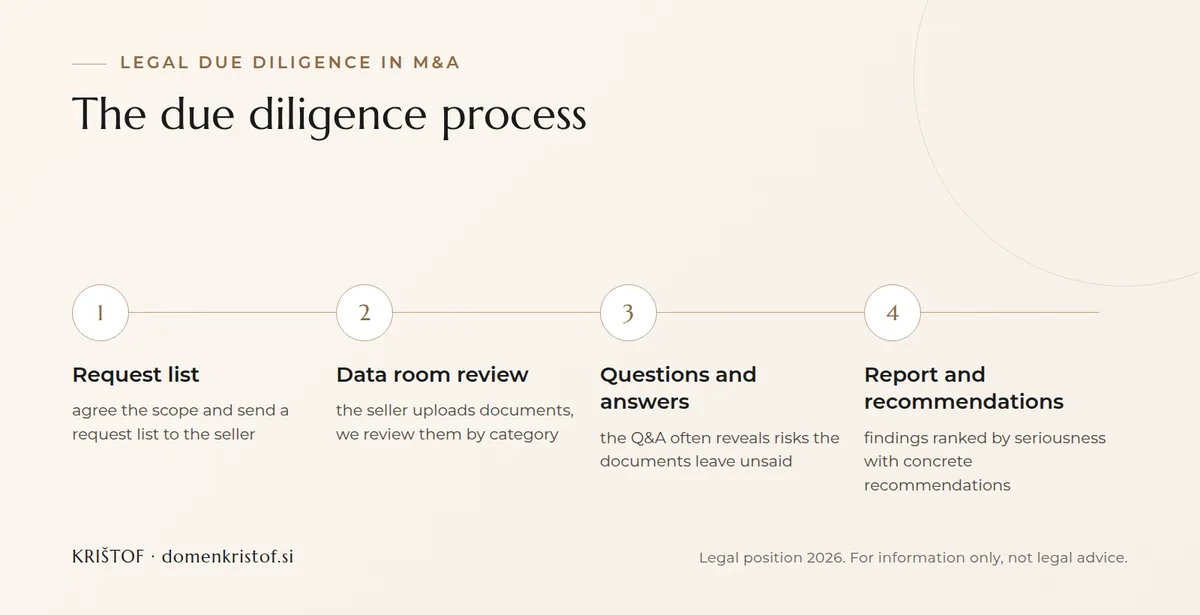
The review begins with a request list, followed by review in the data room, questions and clarifications, and then the report. We align the scope and duration with your timeframe and with how well the company's affairs are in order. For smaller, well-organised companies the review can be quick. For more complex ones it takes several weeks.
How the review proceeds, step by step
In practice, the review follows a predictable sequence. First, we agree the scope and send a request list tailored to the target company's activity. Second, the seller uploads the documentation to a data room, and we review it by category, ownership, contracts, employment, disputes, real estate, intellectual property, permits and tax.
Third, we put together questions and requests for clarification (Q&A), because it is often in the answers that risks emerge which the documents themselves leave unsaid. Fourth, we prepare a report listing the findings, ranked by seriousness, with concrete recommendations on what to resolve before closing, what to cover with a warranty, and what to cover with a dedicated indemnity.
We then build the findings into the sale and purchase agreement (SPA). The review and the agreement are two steps in the same deal. For sellers, we often also carry out a pre-sale review, which connects with the course of a sale from LOI to SPA.
Common pitfalls
The most common buyer mistakes: the review starts too late (after signing the LOI, on a tight timeline), the scope is too narrow (for example, overlooked employment or tax risks), and the findings stay in the report and are not carried over into the warranties. A risk that is known but not covered by the agreement is borne by the buyer after closing, which is why the link between the review and the transaction structure is crucial.
How long does legal due diligence take?
It depends on the size of the company, how well its affairs are in order, and the scope we agree. We tailor the scope and timeline to your deal. For smaller companies the review is usually quicker.
What if the review uncovers a risk?
That is not necessarily a reason to walk away from the deal. It is often the basis for a price adjustment, additional warranties or an indemnity that allocates the risk between the parties.
Does the seller need a review too?
Yes, increasingly so. With a pre-sale review (vendor due diligence) the seller addresses shortcomings in advance and so preserves its negotiating position and the price.
Is a legal review enough, or do I also need a financial one?
A legal review usually runs in parallel with a financial and tax review. Each covers its own set of risks. Together they give a complete picture that carries over into the agreement.
Who bears the cost of the review?
Usually the buyer, who commissions the review in its own interest. With a pre-sale review (vendor due diligence) the cost is borne by the seller, to speed up the deal and preserve the price.
Can the review be done remotely?
Yes. Most of the review is carried out through the data room and written clarifications, so physical presence is generally not required. Where necessary, we also arrange meetings with management.
Legal sources
- Companies Act (ZGD-1), PISRS (in Slovenian)
- AJPES, business register and financial statements
- e-Sodstvo portal (land register, enforcement)
Links point to official sources (PISRS and the competent institutions). This article is general information and is not a substitute for legal advice.