Converting an s.p. into a d.o.o.: steps, tax consequences and pitfalls

Converting an s.p. into a d.o.o. is the transfer of the business to a capital company and, where the conditions are met, it is tax-neutral. We explain the procedure, the deadlines and the most common mistakes.
Converting a sole trader (s.p.) into a limited liability company (d.o.o.) is not merely an administrative step, but a decision about how the business will be liable for its obligations, how it will be taxed and how it will one day pass to the next generation or a new owner. Where the procedure is carried out correctly, the new company, as universal legal successor, steps into all the legal relationships of the transferred business.
Below we explain why entrepreneurs take this step, how the procedure works under the Companies Act (ZGD-1), and where it most often goes wrong.
Why convert
The most common reasons are limiting liability (with an s.p. the entrepreneur is liable with all of their personal assets, whereas with a d.o.o. it is generally only the company that is liable, with its own assets), easier entry of shareholders or an investor, orderly succession and often tax optimisation as the business grows.
Conversion is not always the right choice. At a small scale, the costs and obligations of a d.o.o. may outweigh the benefits. It is sensible to assess the decision for the specific case.
How the procedure works
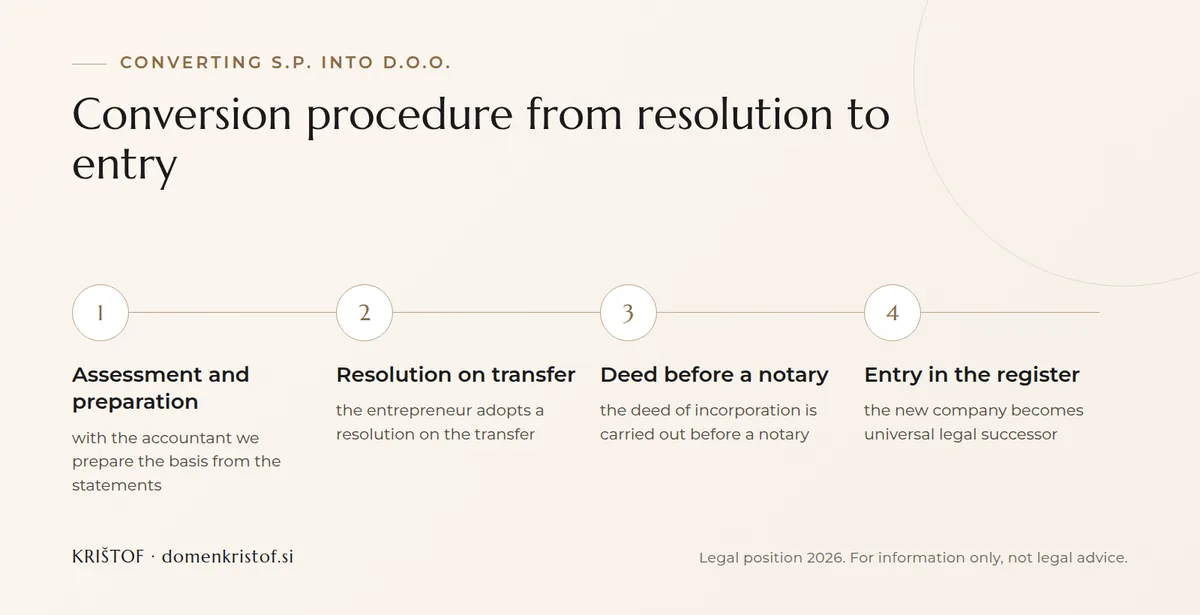
The status conversion procedure under ZGD-1 is based on the transfer of the entrepreneur's business to a new or acquiring company. The entrepreneur adopts a resolution on the transfer, the necessary documentation is prepared (among other things, on the basis of the financial statements), the deed of incorporation or capital increase is concluded, and all of this is carried out before a notary and entered in the court register.
On entry, the company, as universal legal successor, steps into the rights and obligations of the business (contracts, receivables and debts), which means that operations continue without any interruption of relationships. The timeline and documentation are coordinated with the notary and the accountant.
Tax neutrality and the conditions
Where the conditions under tax legislation are met, the conversion can be tax-neutral, that is, without immediate taxation of hidden reserves on the transfer. The conditions relate to retaining the book values and continuing the activity. If they are not met, a tax liability may arise.
Because the tax conditions are precise and the consequences differ from case to case, the tax aspect should be assessed in advance, together with an accountant or tax adviser.
Common pitfalls
The most common problems: contracts and permits that are not in order, which on transfer prove non-transferable without the consent of the counterparty. An incorrectly determined value of the transferred business, and overlooking the tax conditions, causing the conversion to lose its tax neutrality. All three can be anticipated and resolved before the conversion is carried out.
Step by step: from resolution to registration
In practice the procedure runs as follows: 1) we assess whether it makes sense and in what form (a new or an acquiring company) and, with the accountant, prepare the basis from the financial statements. 2) the entrepreneur adopts a resolution on the transfer of the business. 3) the deed of incorporation or corporate instrument is prepared. 4) the procedure is carried out before a notary. 5) entry in the court register follows, on which the new company comes into being and, as universal successor, steps into the relationships of the business.
6) After entry, we deal with the transfers that require consent (for example, certain contracts, permits, banking relationships) and the registration of beneficial owners. Before starting, we check which contracts are non-transferable without consent. This is the most common cause of complications.
Conversion is often the first step in a wider business succession or preparation for a sale, since a d.o.o. makes it easier for shareholders to enter and for interests to be transferred.
When conversion does not (yet) make sense
Conversion is not always the right choice. At a small scale of operations, the additional obligations of a d.o.o. (accounting, governing bodies, formalities) may outweigh the benefits of limited liability. It is sensible to assess the expected growth, the risks of the activity and any plans for shareholders to enter or for a transfer.
The timing in relation to the tax period and coordination with the accountant also matter. We therefore always tie the decision to specific figures and goals. Conversion is often only the first step in wider status and succession planning.
Liability for obligations arising before the conversion
A common question is whether, with a d.o.o., the entrepreneur is relieved of liability for past obligations. The company, as universal successor, assumes the obligations, but for a certain period the law also provides for continued liability for obligations arising before the conversion.
This means that conversion is not a way to avoid existing debts. It is, however, important for limiting liability in future dealings. We assess the specific scope and duration of this liability for your case as part of corporate (status) law.
Does a d.o.o. free me from personal liability for past obligations?
The company is liable for the obligations transferred to it. However, for a certain period the law also provides for liability for obligations arising before the conversion. We assess the specific scope for your case.
Do I keep my tax number and contracts?
The company, as universal legal successor, steps into the relationships of the business, but some contracts require the counterparty's consent to be transferred. We check this in advance.
Is conversion always tax-neutral?
No. Tax neutrality applies where the statutory conditions are met (for example, retaining the book values). If the conditions are not met, a tax liability may arise.
How long does it take?
It depends on how well the documentation is in order and on coordination with the notary and the accountant. We set the timeline at the outset and adapt it to your deadlines.
Do I have to change contracts with partners after the conversion?
The company, as universal successor, steps into the relationships, but some contracts provide that a transfer requires the counterparty's consent. We check and arrange these in advance.
What happens to employees?
Employment relationships generally pass to the new company. We assess the specific obligations regarding information and employees' rights for your case.
Legal sources
- Companies Act (ZGD-1), PISRS (in Slovenian)
- Financial Administration (FURS)
- SPOT, Slovenian Business Point
Links point to official sources (PISRS and the competent institutions). This article is general information and is not a substitute for legal advice.