Selling a company: from the letter of intent (LOI) to the agreement (SPA)

Selling a company usually runs from the letter of intent (LOI), through due diligence, to the sale and purchase agreement (SPA). We explain the steps and where negotiations most often get stuck.
For most owners, selling a company is a one-off and one of the most important business decisions they will make. The path from the first serious conversation to payment of the purchase price runs through several steps, each with its own legal risks and opportunities. Understanding the sequence, the letter of intent, due diligence, negotiations and the sale and purchase agreement, helps the seller keep the initiative and protect the price.
Below we explain the individual phases of selling a shareholding or a company, and where it is most often decided how much the seller will actually receive in the end and how much risk they will carry even after the sale.
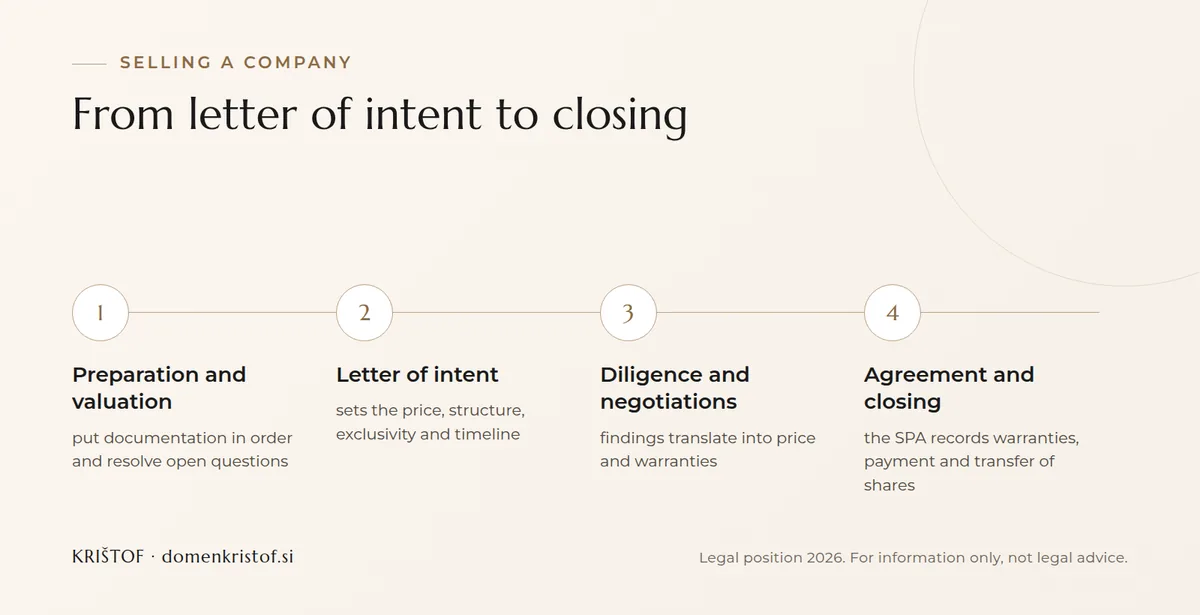
Preparation and valuation
Before the first contact with buyers, it is worth putting the “house” in order: reviewing the ownership structure, key contracts, any disputes and open questions that could lower the price. Many shortcomings can be addressed in advance. That is the point of a pre-sale review (vendor due diligence).
In parallel, a presentation of the company is prepared and initial expectations are set as to the price and the structure of the deal (a share sale or an asset sale, which differ in tax and legal terms).
The letter of intent (LOI) and confidentiality
Once a serious buyer is found, the parties often sign a letter of intent (LOI). This sets out, in outline, the price, the structure of the deal, the timeline and the exclusivity of the negotiations. Most provisions of an LOI are non-binding, but some, confidentiality, exclusivity and costs, are usually binding.
Before any exchange of sensitive information, a non-disclosure agreement (NDA) is also signed. A carefully drafted LOI prevents later disagreements about “what exactly we agreed”.
Due diligence and negotiations
The buyer carries out due diligence on the company. Its findings become the material for negotiations on price and warranties. The seller is in a stronger position here if the documentation is in order and the risks have been anticipated in advance.
Negotiations do not revolve around price alone, but also around the scope of the warranties, limitations of liability, retention of the purchase price and the conditions to closing. It is often these provisions, rather than the nominal price itself, that have the greater effect on the final proceeds.
The sale and purchase agreement (SPA) and closing
The agreement is recorded in a sale and purchase agreement (SPA), which governs the price and method of payment, the representations and warranties, the limitations of liability, the covenants up to closing and the conditions to closing. Closing then follows: the fulfilment of the conditions, payment of the purchase price and transfer of the shareholding (for a d.o.o., usually by notarial deed and entry in the court register).
After closing, the seller's obligations under the warranties often remain for a certain period. That is precisely why how the warranties and limitations of liability are drafted matters.
An example of the sale process, step by step
Take an owner selling a d.o.o. 1) Preparation: we put the documentation in order, resolve open questions and, where needed, carry out a pre-sale review. 2) Contact and confidentiality: we sign a non-disclosure agreement (NDA) with a serious buyer, after which the due diligence takes shape.
3) Letter of intent (LOI): we define the price, the structure, exclusivity and the timeline. 4) Due diligence and negotiations: the buyer's findings are translated into price and warranties. 5) Agreement (SPA): we record the deal, including the warranties and limitations of liability. 6) Closing: the conditions are fulfilled, the purchase price is paid and the shareholding is transferred by notarial deed and entry in the court register.
In family businesses, a sale is often part of a wider business succession, where a sale to a third party is weighed against a transfer to a successor.
What to watch for as a seller
Sellers most often lose part of their proceeds in the fine print, not on the price. Particular attention is needed for the scope of the warranties (as narrow as possible and tied to your actual knowledge), the limitations of liability (a cap and time limits, without them you remain liable for too long) and the method of payment (an upfront payment versus a retention or an earn-out tied to future performance).
Consider, too, the tax effect of the chosen structure and any non-compete restriction after the sale. We align these questions with the terms of the sale and purchase agreement, so that the agreed price also remains the actual proceeds.
Payment structure: upfront payment, retention, earn-out
The price is rarely just a single figure at closing. Combinations are common: an upfront payment at closing, a retention (escrow/holdback) as a source for any warranty claims, and an earn-out, part of the price tied to the company's future performance after the sale.
Each form allocates risk differently: an earn-out is risky for the seller if they no longer have influence over the business after the sale, so protective rules are agreed. We set these mechanisms out precisely in the sale and purchase agreement, so that there is no later dispute about how much and when.
Is a letter of intent (LOI) binding?
Mostly not. It sets out the framework of the deal. As a rule, however, the provisions on confidentiality, exclusivity and costs are binding. Which parts are binding depends on the wording, so precision matters.
Is it better to sell the shareholding or the company's assets?
It depends on the tax and liability consequences for both sides. A share sale and an asset sale differ. We carry out the legal and tax assessment for your specific case.
How long does the seller remain liable after the sale?
For as long as the agreement provides, through the warranties and the time limits for bringing claims. These time limits and limitations of liability can be negotiated. Without them, liability can last too long.
Do I need a lawyer if I already have a broker?
A broker finds the buyer. A lawyer protects your legal position in the agreement. The two roles do not overlap. The legal preparation of the agreement and the warranties is separate from finding a buyer.
How long does selling a company take?
From a few weeks to several months, depending on the size of the company, how well its affairs are in order, and the complexity of the negotiations. Good preparation shortens the process.
Do I have to pay tax before the sale?
A sale has tax consequences that vary according to the form of the deal and the person of the seller. We assess the tax aspect together with a tax adviser before the deal is concluded.
Legal sources
Links point to official sources (PISRS and the competent institutions). This article is general information and is not a substitute for legal advice.