Shareholder exit and exclusion: rights, procedure and the value of the interest

A shareholder may exit a d.o.o. or be excluded on justified grounds, and the heart of the dispute is most often the value of the interest. We explain the procedure, the rights and how the value is determined.
Joining a company is usually easier than leaving it. When cooperation between shareholders is no longer possible (because of deep disagreement, breaches or a decision-making deadlock), the question arises of how someone can leave the company or how a problematic shareholder can be removed from it. Exit and exclusion are governed by the Companies Act (ZGD-1) and often, in addition, by the shareholders' agreement.
Below we explain the difference between exit and exclusion, how the value of the interest is determined, and why settling matters in advance in a shareholders' agreement is so important.
Exit of a shareholder
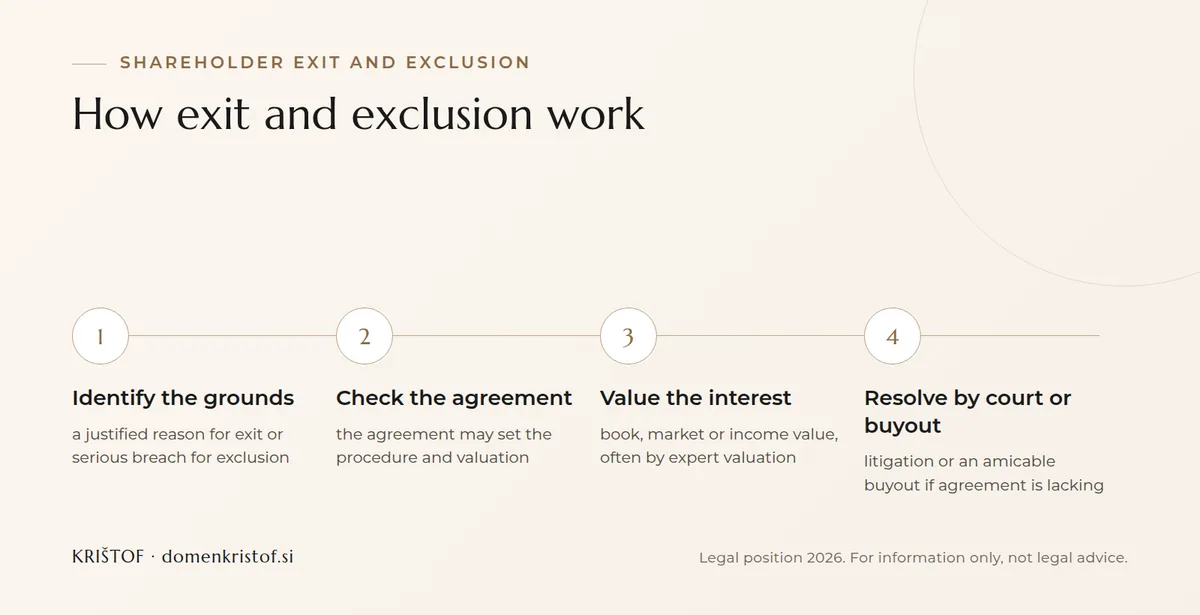
Exit is the act of a shareholder who wishes to leave the company, usually for a justified reason where remaining in the company can no longer be expected of them (for example, lasting disagreement or prejudice to their interests). The procedure and conditions may be set out in the articles of association or the shareholders' agreement. Otherwise the statutory rules apply. As a last resort, exit is decided by the court.
On exit, the shareholder is generally entitled to be paid the value of their interest, which opens the central question: valuation.
Exclusion of a shareholder
Exclusion is the removal of a shareholder against their will, where their conduct causes harm to the company or prevents it from functioning (for example, a serious breach of obligations). Exclusion too is generally pursued through the courts, unless the agreement provides a different mechanism.
Both exit and exclusion are demanding and often contentious. Without advance arrangement, the procedure can drag on and paralyse the company.
Determining the value of the interest
The most common stumbling block is the value of the ownership interest. If the valuation method is set in advance (in the shareholders' agreement), there is less dispute. Otherwise the value is established by an expert valuation, with the parties often disagreeing on the method (book value, market value, income value).
It is sensible to determine in advance how the interest is valued, as at when (on which date) and how it is paid (in a lump sum or in instalments), so that a new dispute does not arise on exit.
Why arranging matters in advance counts
A shareholders' agreement can settle exit and exclusion calmly and predictably: it defines the grounds, the procedure, the valuation method and the manner of payment. Without it, every such question is resolved from scratch, often before a court, with an uncertain outcome and high costs for everyone involved.
An example: exit on a lasting deadlock
A common scenario: a shareholder disagrees with the company's direction, decision-making is deadlocked, and cooperation has become unbearable. If the shareholders' agreement governs exit, we act under it, with the agreed valuation method and manner of payment. If it does not, exit is pursued under the law, as a last resort through the courts.
It is essential, from the outset, to secure the evidentiary position (minutes, correspondence, resolutions), since the value of the interest and the merits of the ground are often assessed retrospectively. In parallel, we check whether an amicable solution is possible: a buy-out of the interest by the other shareholders or a third party.
Exit and exclusion are part of the wider protection of the company. When they grow into a dispute over value or conduct, they carry over into a commercial dispute.
Costs, time and amicable solutions
Litigation over exit or exclusion can be lengthy and expensive, with an uncertain outcome, particularly where the value of the interest is disputed. That is why, before going to court, we always check the possibility of an amicable solution: a buy-out of the interest by the other shareholders or a third party, a determination of the value by agreement, or a gradual exit.
Where there is a shareholders' agreement with an agreed valuation method, the procedure is faster and cheaper. When a dispute does go to court, we conduct it as a commercial dispute with careful preparation of the evidence.
How an interest is valued in practice
The value of the interest is the most common subject of dispute. In practice, different methods are used: book value (the balance-sheet value), market value (the achievable sale price) and income value (expected returns). Each can produce a substantially different result.
Without a method agreed in advance, the value is established by an expert valuation, and the parties often disagree on the approach, hence long disputes. That is why, in the shareholders' agreement, we recommend that the method and the valuation date be set in advance.
What to prepare for the initial consultation
It helps to have: the articles of association and any shareholders' agreement, the ownership structure, documentation of the contested conduct or deadlock (minutes, resolutions, correspondence) and accounting data for valuing the interest.
On this basis we assess the options of exit, exclusion or an amicable solution, and the approach to valuation, part of protecting the company or of commercial disputes.
Can a shareholder exit at any time?
Not without a basis. Exit is generally tied to a justified reason or to the rules of the shareholders' agreement. Otherwise, as a last resort, it is decided by the court.
How is it determined how much I am entitled to for my interest?
By the value of the interest, established by an expert valuation if the method has not been agreed in advance. That is precisely why it is sensible to set the method and the valuation date in the shareholders' agreement.
Can we exclude a shareholder because of disagreements?
Only on justified grounds (for example, a serious breach or prejudice), generally through the courts or by the mechanism in the agreement. Disagreements alone, without breaches, are generally not enough for exclusion.
How long does such a procedure take?
It depends on whether it is governed by the agreement or proceeds through the courts, and on how contested the valuation is. Arranging matters in advance shortens the procedure considerably.
Who pays the value of the interest on exit?
Generally the company or the other shareholders, depending on the basis and the agreement. The manner and timing of payment may be set in the shareholders' agreement.
Does exit also mean the end of personal guarantees?
Not necessarily. Personal sureties or guarantees for the company's obligations may remain in force. They must be dealt with separately on exit.
Legal sources
Links point to official sources (PISRS and the competent institutions). This article is general information and is not a substitute for legal advice.