The shareholders' agreement (SHA): why you need one and which clauses count

A shareholders' agreement is an agreement on matters that the articles of association do not govern, and it is not made public. We explain which clauses count and why to conclude one while relations between shareholders are good.
While there is consensus in the company, a shareholders' agreement seems unnecessary. But once a disagreement arises (over the distribution of profit, the direction of development, the entry of an investor or the exit of one of the shareholders), it is often too late for an amicable arrangement. A shareholders' agreement (SHA) is an agreement among the shareholders that sets the rules of the game in advance.
Below we explain how an SHA differs from the articles of association, and which clauses, in practice, most reliably prevent disputes.
An SHA and the articles of association: what is the difference
The articles of association (or the deed of incorporation) are the company's public founding instrument, entered in the court register. A shareholders' agreement is usually a confidential agreement among the shareholders that governs their mutual relationships in more detail and often contains provisions the owners do not wish to disclose to the public.
The two complement each other: some matters must be governed in the articles of association, while others are better suited to a confidential shareholders' agreement.
Clauses on the transfer of interests
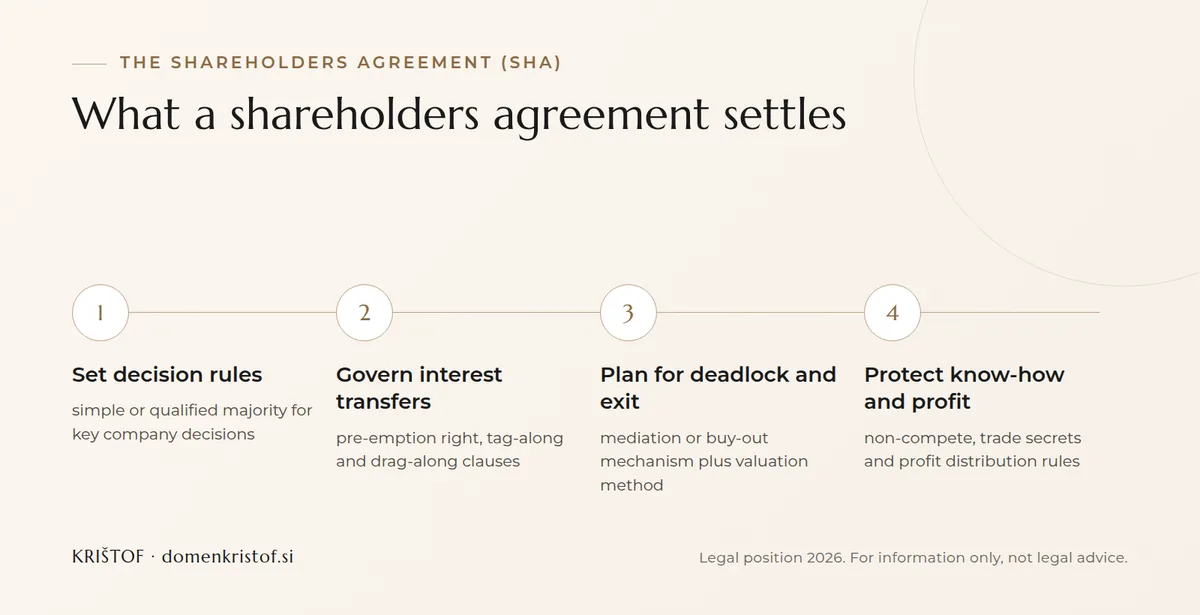
At the heart of an SHA are the rules on when and to whom an interest may be transferred: the pre-emption right of the other shareholders, the right to join a sale (tag-along) for minority shareholders, and the right to compel participation in a sale (drag-along) for majority shareholders. Without these clauses, a shareholder may sell their interest to a person the others find unacceptable.
Decision-making, deadlocks and exit
An SHA determines what is decided by a simple majority and what requires a qualified majority (for example, borrowing, the sale of assets, the admission of new shareholders). It also provides mechanisms for resolving a deadlock where the shareholders cannot agree, as well as rules on the exit and exclusion of a shareholder and the determination of the value of the interest.
Protecting know-how, competition and profit
Often a non-compete restriction, the protection of trade secrets, the policy on profit distribution and the rules on financing the company (for example, an obligation to contribute further capital) are also settled. The aim is for expectations that shareholders often merely assume to become written down and enforceable.
An example: how an SHA prevents a deadlock
Imagine a company with two equal shareholders (50:50). Without an agreement, every more important question on which they disagree causes a deadlock. The company stalls. A shareholders' agreement prevents this in advance: it determines what a simple majority suffices for, what requires consent, and introduces a mechanism for resolving a deadlock (for example, mediation or a buy-out mechanism).
The agreement also governs what happens on the exit or exclusion of a shareholder and how the value of the interest is determined, which is otherwise the most common source of disputes. These are all matters that are easiest to arrange while there is still consensus among the shareholders.
The shareholders' agreement is at the heart of protecting the company and is often prepared on the entry of an investor or as part of business succession.
When to conclude it and what to include
The best moment for a shareholders' agreement is on incorporation or on the entry of a new shareholder or investor, that is, while there is still consensus. Concluding one in the middle of a dispute is harder and more expensive, but still worthwhile.
A sensible set includes: the rules of decision-making and qualified majorities, the transfer of interests (pre-emption right, tag-along, drag-along), resolution of deadlocks, exit and exclusion with a valuation method, a non-compete restriction and a profit policy. We tailor the agreement to the size and activity of the company as part of protecting the company.
Financing, capital increases and trade secrets
A shareholders' agreement often also governs the financing of the company: whether and on what terms the shareholders are obliged to contribute further capital or loans, and what happens if one of them does not take part (for example, dilution of their interest).
The protection of trade secrets and a non-compete restriction are also settled, so that a departing shareholder does not take know-how and clients to a competitor. These matters are part of protecting the company and connect with the exit of a shareholder.
What to prepare for the initial consultation
It helps to have: the articles of association or deed of incorporation, the ownership structure and the interests, any existing agreements among the shareholders, and the key open questions (decision-making, the entry of an investor, exit).
On this basis we prepare a shareholders' agreement tailored to your company, as part of protecting the company.
Is a shareholders' agreement mandatory?
It is not required by law, but it is strongly recommended wherever there is more than one shareholder. Without it, only the general rules apply, which often do not match the owners' actual expectations.
What is the difference between tag-along and drag-along?
Tag-along protects the minority: the right to join a sale on the same terms. Drag-along protects the majority: the right to compel the minority to sell when the whole is sold.
Can we conclude an SHA later as well?
Yes, it can be concluded at any time with the shareholders' consent. It is easier while there are no open disputes. Later, agreement is harder, but still worthwhile.
Is an SHA public?
As a rule, no. It is a confidential agreement among the shareholders, unlike the articles of association, which are entered in the public court register.
What is a deadlock clause?
A provision for resolving a deadlock between equal shareholders, from mediation to buy-out mechanisms (for example, an offer to buy out an interest). It prevents a disagreement from paralysing the company.
Does an SHA apply if it conflicts with the articles of association?
The relationship must be aligned. Some matters must be in the articles of association. A shareholders' agreement complements them, but does not override them. We check the alignment when preparing it.
Legal sources
Links point to official sources (PISRS and the competent institutions). This article is general information and is not a substitute for legal advice.