Business succession: transferring the company calmly and in good time

A company can be transferred to a successor during one's lifetime or on inheritance, and the routes differ greatly in legal and tax terms. We compare the options and point out the pitfalls of each.
Transferring a company to the next generation or a new owner is one of the most sensitive moments in the life of a family business. When it is not prepared in advance, it is often triggered by an unexpected event, and decisions are then made under time and emotional pressure. Planning in good time preserves the value of the company and relationships within the family.
Below we set out the options for a transfer, the role of the shareholders' agreement, and the connection with inheritance and the tax consequences.
The transfer options
A company can be transferred in several ways: by a transfer of the ownership interest (for value or without consideration), by a gradual handover of management while ownership is retained, by a capital increase and the entry of the successor, or by a sale to a third party. Each route has different tax and liability consequences.
A combination often makes sense, for example, a gradual handover of management alongside a parallel settling of ownership, so that the successor takes on responsibility gradually rather than overnight.
The role of the shareholders' agreement
Where more than one shareholder remains in the company (for example, several children or an external partner), a shareholders' agreement is a key tool. It governs the rules of decision-making, the transfer of interests, pre-emption rights, the resolution of deadlocks and exit. Without it, differences in expectations quickly translate into a dispute.
In family businesses, it is sensible to separate the role of owner from the role of manager in advance, and to determine who decides what.
The connection with inheritance and the compulsory share
Business succession must be aligned with inheritance law. If only one descendant receives the company, the others may claim a compulsory share, which can threaten liquidity or even the integrity of the company. Much can be arranged in advance with a will, a transfer agreement or a lifelong-support contract.
The aim is for the transfer of the company and the arrangement of the remaining assets to work in harmony, which requires corporate and inheritance law to work together.
The tax aspect and the timeline
A transfer of an interest has tax consequences that differ depending on whether it is for value or without consideration and on the family relationship between the parties. We assess the tax aspect together with a tax adviser. Because succession is a process and not a one-off event, it is sensible to start planning it early.
An example: a gradual transfer of a family business
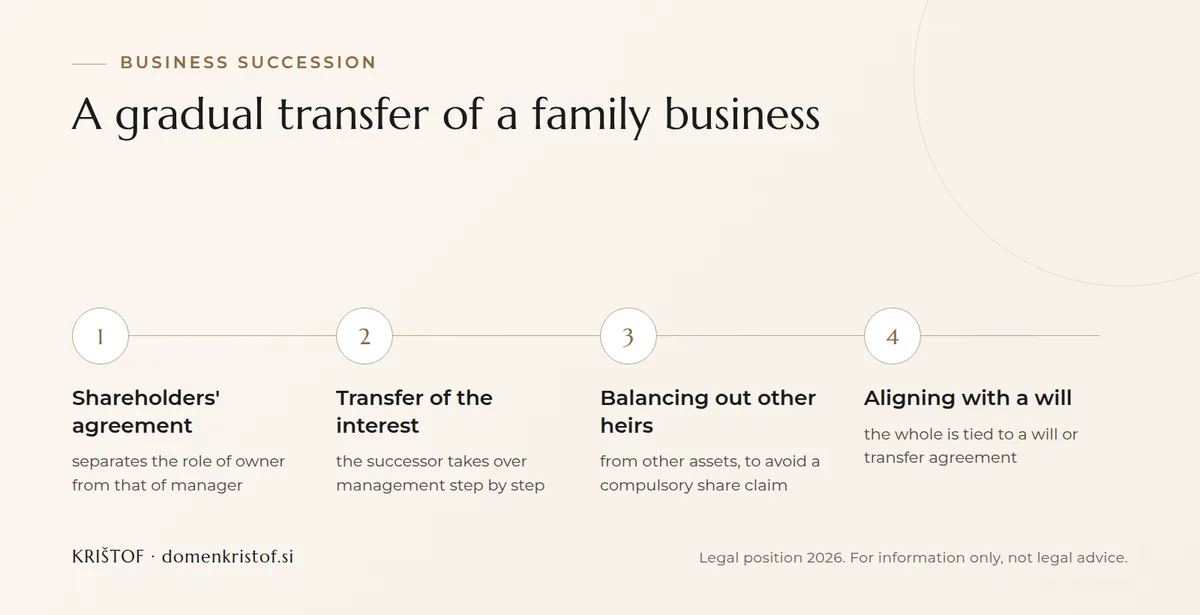
A typical scenario: an owner wishes to transfer the company to one of two children who is active in the business, without disadvantaging the other. A common solution is a combination of steps: 1) we put in place a shareholders' agreement that separates the role of owner from that of manager. 2) the interest is transferred gradually (for example, in phases) while the successor takes over management.
3) we balance out the other child from other assets (real estate, savings), to avoid a later claim to a compulsory share in the company. 4) we align the whole with a will or a transfer agreement. In this way the transfer does not threaten the company's liquidity and preserves relationships within the family.
Because corporate and inheritance law are intertwined, we manage the transfer in an integrated way, from the corporate (status) arrangement to inheritance planning.
Common mistakes in a transfer
The most common mistakes: the transfer starts too late (on illness or an unforeseen event), succession is arranged without a shareholders' agreement, the compulsory share of other heirs is overlooked, and the tax effect is assessed only after signing.
Another pitfall is mixing roles: owner, manager and family member at once, without clear rules of decision-making. That is precisely why we design the transfer as a process with milestones, not as a one-off signature, and align it with inheritance planning.
Tools of transfer: a gift, a transfer agreement, lifelong support
There are several legal tools for transferring assets to a successor, with different effects. A deed of gift is simple, but gifts may be brought into account against the compulsory share. A transfer agreement (izročilna pogodba) allows the ancestor to divide assets among descendants during their lifetime, under particular conditions.
A lifelong-support contract or a preužitek arrangement (a reserved lifetime benefit under Slovenian law) ties the transfer to the care of the ancestor. The choice depends on the objectives and family relationships. We often combine them with a will as part of inheritance planning.
What to prepare for the initial consultation
It helps to have: the company's ownership structure and the interests, an overview of assets (the company, real estate, savings), a picture of any successors and heirs in the family, and your goals regarding management and ownership.
On this basis we propose a route for the transfer, aligned with inheritance planning and corporate (status) law.
When should I start planning succession?
As early as possible, ideally while the company is still operating stably. Planning under the pressure of an unexpected event is more expensive and more risky.
What if only one child receives the company?
The other heirs may claim a compulsory share. This can be anticipated and arranged in advance (for example, by balancing out from other assets), so that the transfer does not threaten the company.
Is transferring an interest to a child taxed?
The consequences depend on whether the transfer is for value or without consideration, and on the family relationship. We assess the tax aspect for the specific case together with a tax adviser.
Do I need a shareholders' agreement if there are two successors?
As a rule, yes. A shareholders' agreement settles decision-making, the transfer of interests and the resolution of disagreements in advance, and prevents deadlocks and disputes.
Is it better to gift or sell the interest to a successor?
It depends on the tax consequences and the family's liquidity. A gift and a transfer for value have different effects. We assess the solution together with a tax adviser.
What if the successor is not (yet) ready to run the company?
A gradual handover of management while ownership is retained is possible, or temporary professional management. A shareholders' agreement can govern this period clearly.
Legal sources
- Companies Act (ZGD-1), PISRS (in Slovenian)
- Inheritance Act (ZD), PISRS (in Slovenian)
- Financial Administration (FURS)
Links point to official sources (PISRS and the competent institutions). This article is general information and is not a substitute for legal advice.